
Felicidades!
Venezuela overcomes Team USA to win the country’s first-ever WBC title.

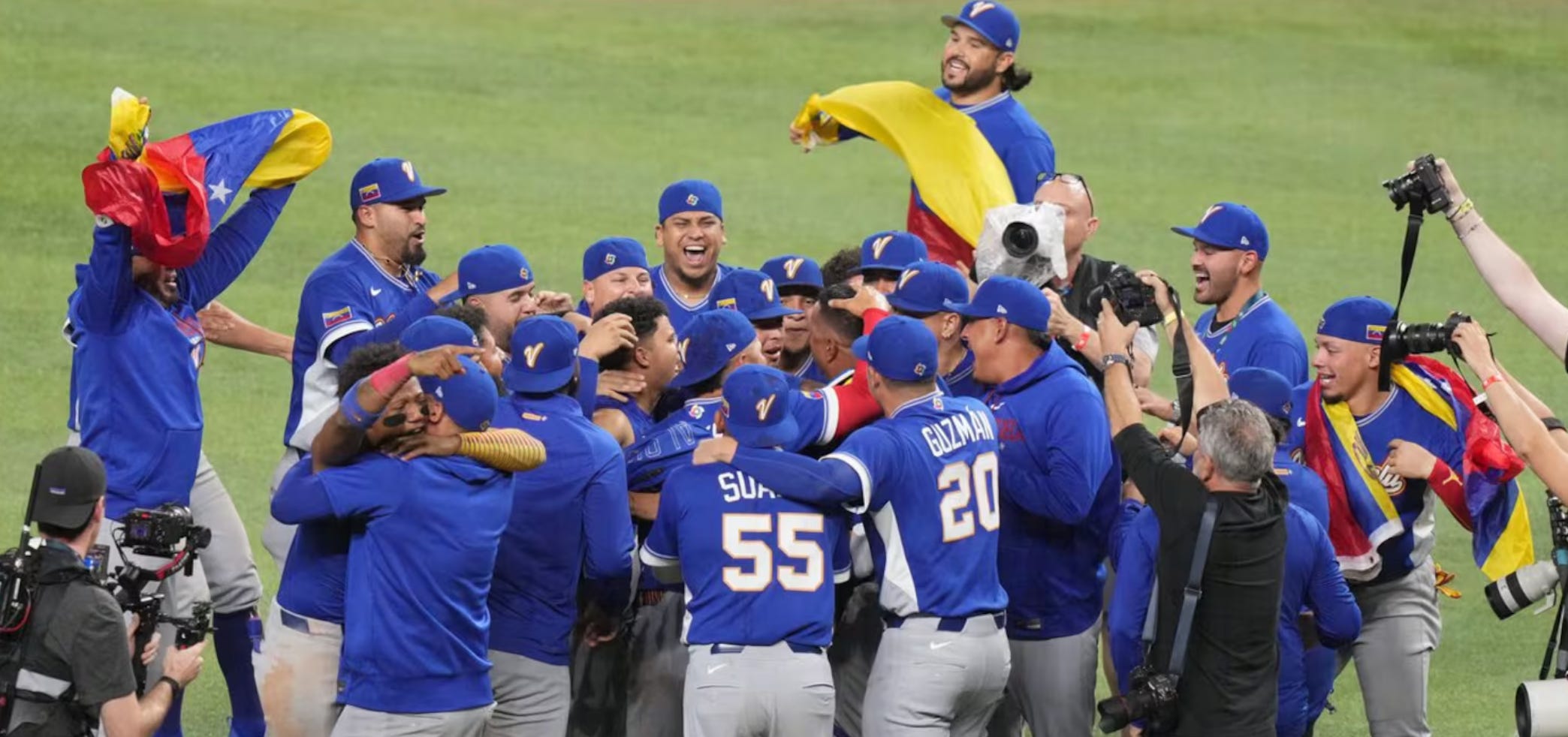
If you’re one of that dwindling group of people who still might believe the World Baseball Classic is just some kind of glorified exhibition series, I hope the past couple of weeks have proved it’s time to think again.
As Hannah Keyser wrote for CNN:
“It doesn’t mean anything in the grand scheme of things that Team USA — the United States of America, as in the birthplace of baseball and the home to the highest-caliber league on the planet — lost one game against Team Venezuela.
“Except to the Venezuelan players and their fans, to whom it means everything. And, after two weeks of some of the most joyous and exuberant baseball that any March has ever seen, that is the beautiful thing about the World Baseball Classic.”
I totally get that MLB fans – especially before the season starts – will usually put their own team loyalties above the national pride of the players on their roster, and that there are worries about ‘unnecessary’ injuries to stars (the Edwin Diaz situation last time out obviously looms large).
But having genuinely meaningful baseball in March as a prelude to the regular season? Come on, doesn’t the game need the kind of unbridled joy inspired by Tuesday’s final, as well as this competition’s other matchups? And shouldn’t it thrive on the celebration that it is now a truly global sport?
As Molly Knight writes, “The best sport in the world keeps getting better.”
If anyone ever doubted that the standard and quality in teams other than the US was just as good as that of “homegrown” American players, thank goodness that mindset has been put to bed as more fans have tuned in to watch over the past couple of tournaments.
In 2023, Japan beat the US in a dramatic finale; this year, given everything that has recently surrounded the Venezuelan players and people, the fact that they beat both of last time’s finalists – and the top two favorites – their victory offered some small karmic resolution on the field for the uncertainty and chaos they’d experienced away from it.
There were plenty of memorable moments through the tournament. Here’s a video montage of Venezuela’s top moments on their way to the title.
Or, the short version:
And yet, real life always finds a way to intrude…
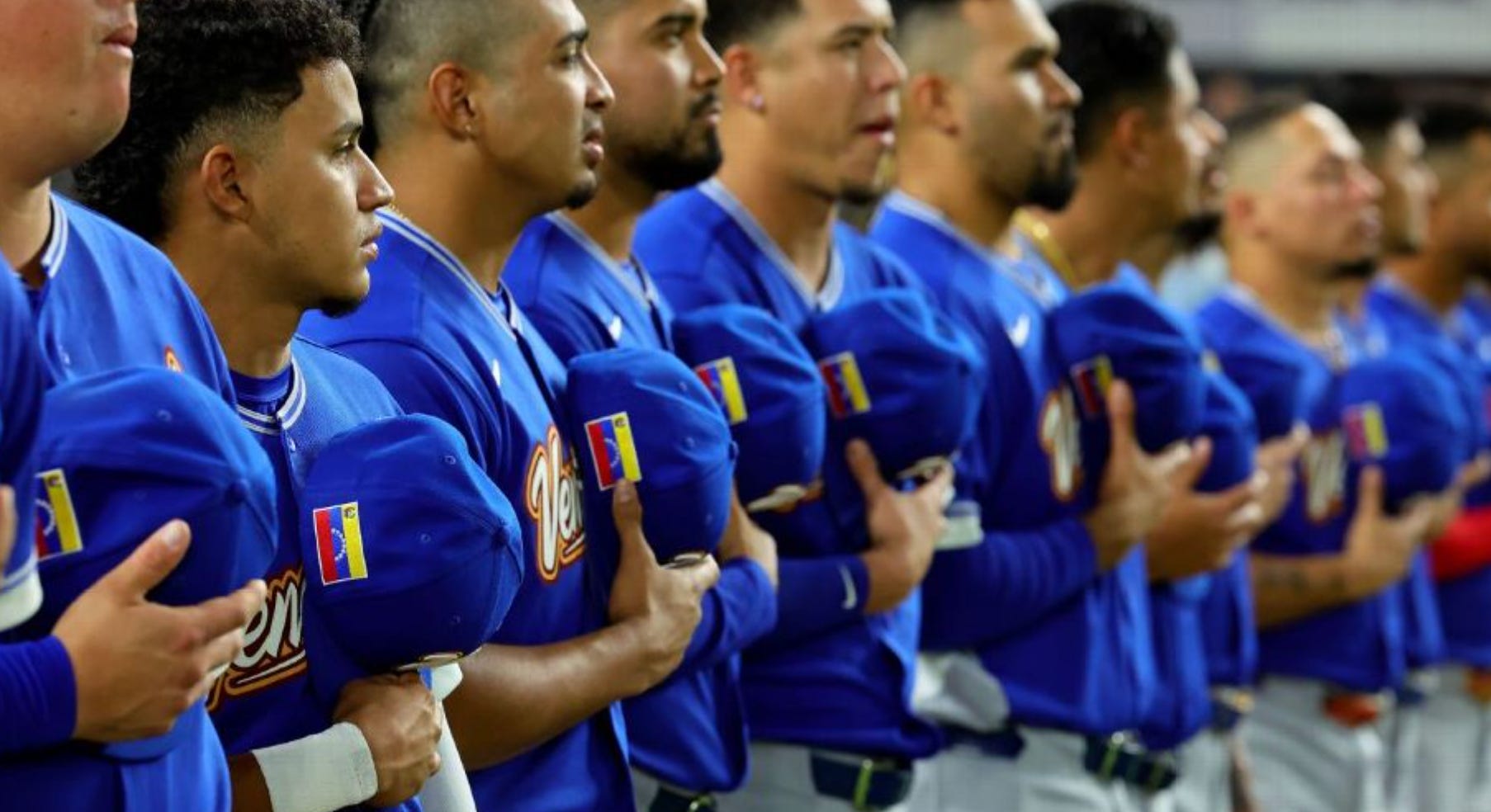
If only that pure happiness and pride in everything the game offers was universal…
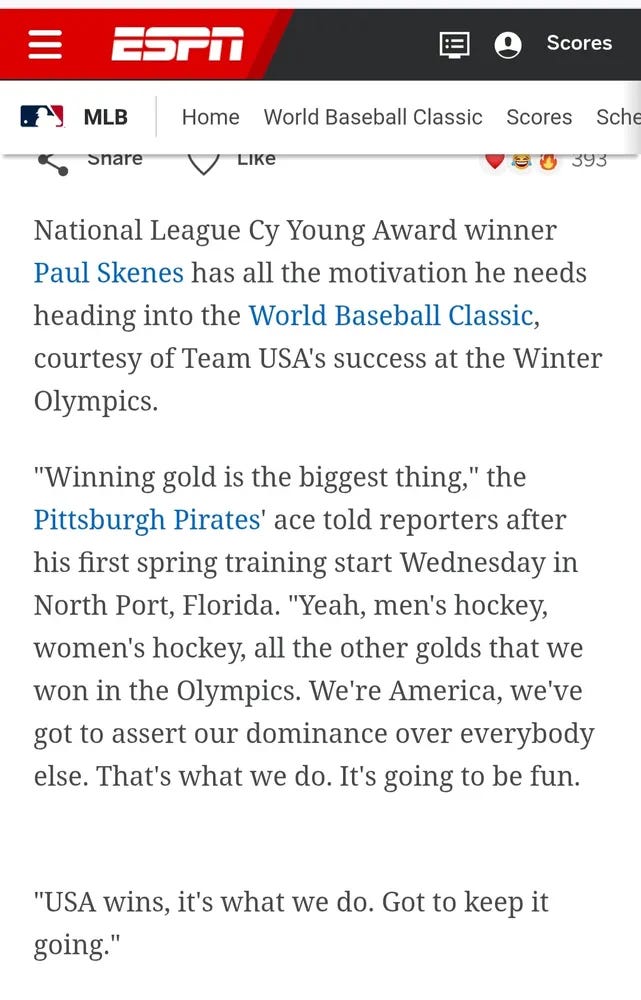
Howard Bryant writes at The Guardian on how while “other nations danced for joy at the World Baseball Classic, Team USA played toy soldiers.”
“The WBC was a two-week block party. Canada, fresh off the Toronto Blue Jays’ American League pennant, reached the quarter-finals for the first time. Venezuela played with heart and national pride (the players even had a drum in the dugout, each base hit a party), the Dominicans with the verve characteristic of the Serie del Caribe, and in a surprising semi-final run, the Italians adopted the underdog spirit of a soccer nation intent on proving they can swing the lumber, too – all while sipping espresso in the dugout.
“What was the American cultural export during this global baseball fiesta? War.”
And sure enough, it seemed like the symbolism of a nation at “war” was like a weight around the collective necks of Team USA, from the locker room pep-talk by a member of Seal Team Six to a petty refusal to shake hands with club teammates from opponent countries.
Joshua Diemert at Pinstripe Alley writes:
“There are many that will chide me for bringing politics into sports, that the WBC is a vehicle to get away from all the rest of the world, but your own team refused to allow that to happen. Thirty grown men—more than that, but I’ll complain about the silliness of moving players on and off your roster later—openly played army guy for two weeks, throwing themselves prostrate before missile launches and drone strikes. Team USA took a side. They brought politics into sports.
“I think it says something about the American mind that this is how a collection of players from across the country would choose to market themselves.”
It’s probably little comfort for disappointed American fans that coach Mark DeRosa likely won’t be back for the next go-round, but there are definitely some lessons that can be learned on and off the field.
As Howard Bryant continues:
“In the final, when [Bryce] Harper’s dramatic two-run homer in the bottom of the eighth tied the game at 2-2, his celebration of choice rounding third was a military salute to the Team USA bench and a stare into the television camera, pointing at the American flag shoulder patch on his jersey. Suddenly, it was the 9/11 era all over again.
“Except that it wasn’t. The gestures were hollow, performative. The Americans peacocked, on guard in a constant state of war. America alone, standing guard when everyone else was having fun. At the WBC, Team USA seemed not part of a baseball celebration but doing their part for a nonexistent war effort. Only the camo was missing.”
Harper, incidentally, was first to congratulate the Venezuelan players at the end of the game.
But let’s leave it there until next time – whenever that might be – by once more celebrating the very best of this tournament.
See Also:
‘Just Let Us Be Happy’ (from January)
and
(For what it’s worth, I love the WBC – both the global idea and its execution. You can read my Game Notes from the 2023 pool games in Phoenix here and about an interesting encounter I had with a fellow fan on that trip here.)
**
Wanna Bet?
It seems odd, to say the least, while the case against Cleveland pitchers Emmanuel Clase and Luis Ortiz is ongoing, that MLB might decide to get into bed with the controversial prediction market Polymarket. But, here we are.
In other deals this week, the Chicago Cubs broadcaster Marquee Sports Network is back on Hulu and Amazon Prime; meanwhile, the Los Angeles Dodgers agreed to a deal with fashion giant Uniqlo to become “Dodger Stadium’s ‘official field presenting partner’, multiple sources tell The Athletic, attaching a sponsorship to the historic ballpark for the first time in its 64-year history.”
“Uniqlo does not have the naming rights to Dodger Stadium itself, as the team reportedly made it a priority to keep the only name the ballpark has ever had intact.
“That has never been for sale,” team president Stan Kasten told the Los Angeles Times in 2017. “It never will be for sale.”
See Also:
Hustle (May, 2025)
Batting Around (July, 2025)
Which Pastime, Exactly? (November 2025)
**
Minor Changes
As Jayson Stark writes at The Athletic, crediting FanGraphs, there’s a “host” of potential new rule changes on deck for Minor League ball this season.
“Many of the new 2026 rules are certain to raise eyebrows, not to mention the blood pressure of minor-league managers and executives. But unlike the pitch clock and ball-strike challenge system, which also began as minor-league experiments, there is no guarantee you will ever see any of these changes at a major-league ballpark near you.
“For nearly a decade now, MLB has used the minor leagues as a test lab for all sorts of ideas — some sport-changing, some that were quickly abandoned. The 2026 changes are viewed as experimental, not inevitable. But in player development departments across baseball, officials are already scrambling to educate players and staff on what they’re about to encounter.”
See Also:
Challenging The System (from September)
**
Play Ball
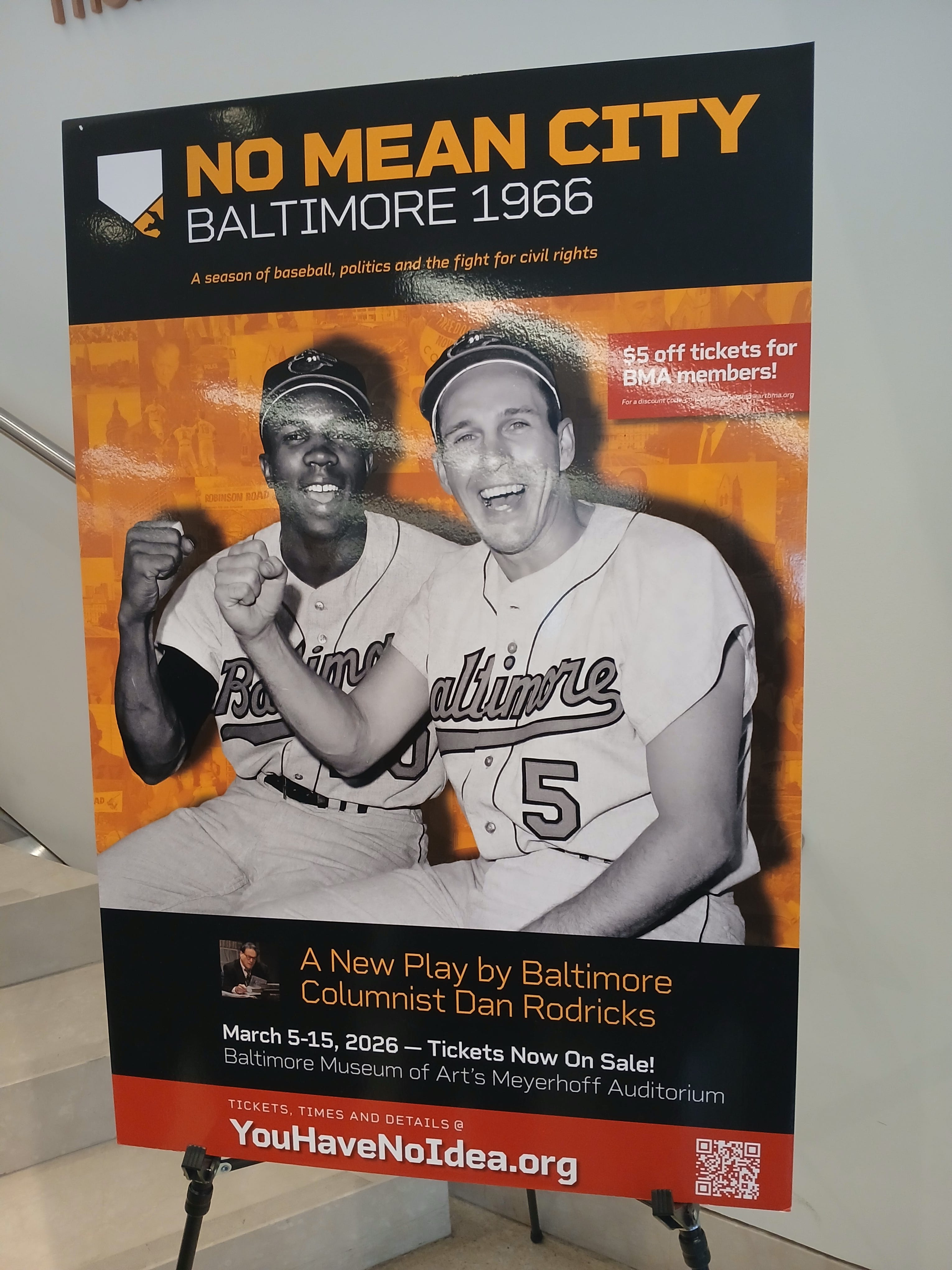
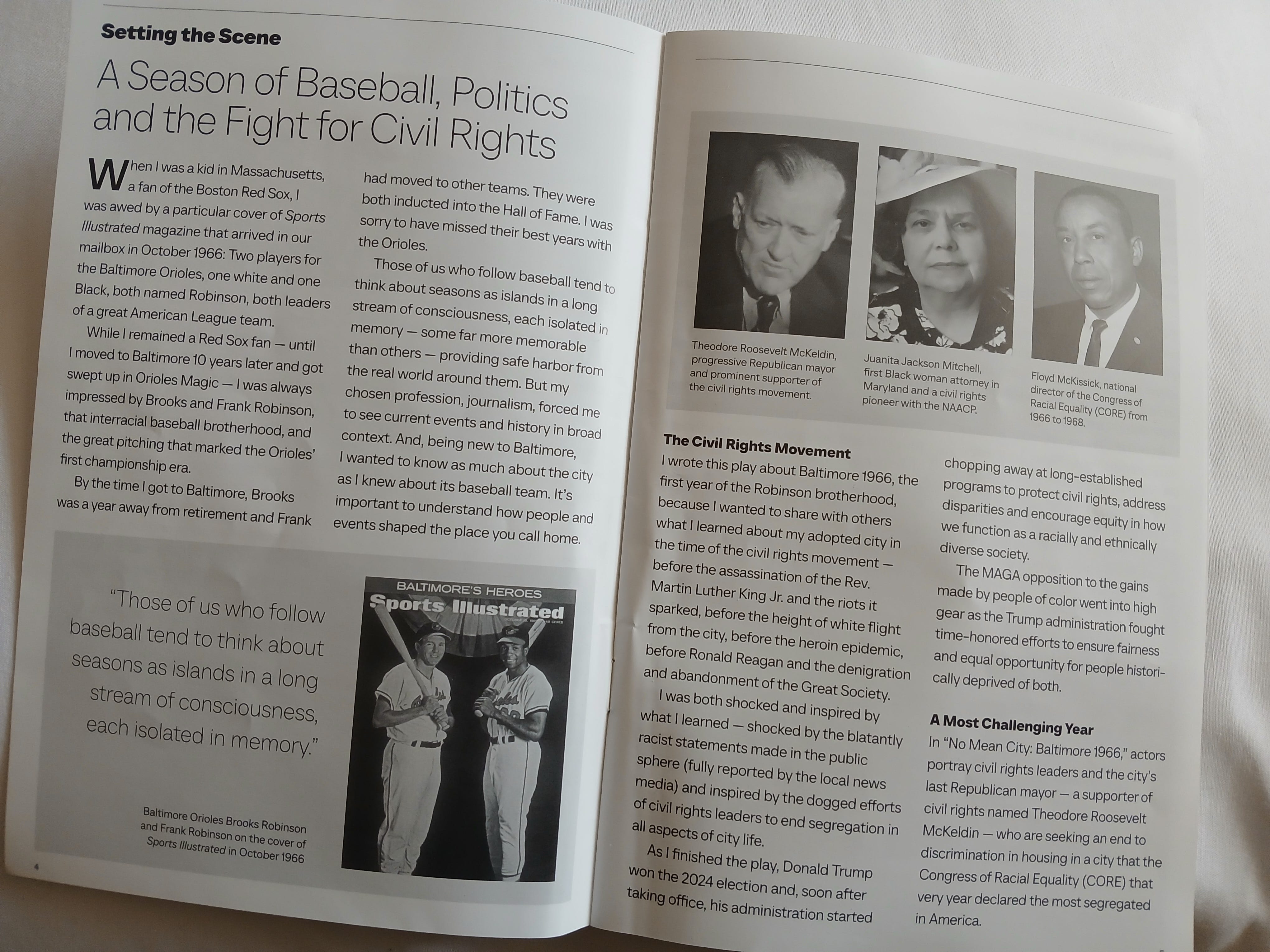
Finally, as if we didn’t have enough drama in our lives, we went to the theatre at the weekend here for one of the final performances in this run of an excellent play, by veteran local journalist and commentator Dan Rodricks, called “No Mean City” about Baltimore in 1966 – told through the narrative combination of the fight for civil rights and the dominant Orioles’ World Series championship, powered by Brooks and Frank Robinson.
It’s a thoroughly enjoyable and thought-provoking piece of work, particularly for someone like me who’s a relative newcomer to the city, but certainly feels both its beauty and pain.
Where I grew up, we had more than our share of local politicians who goaded and riled up their base, provoking people to turn to them in fear, of both change and progress.
Dan himself writes about his work here:
“I wrote a play about Baltimore in 1966, the first year of the Robinson brotherhood, because I wanted to share with others what I learned about my adopted city in the time of the civil rights movement — before the assassination of the Rev. Martin Luther King Jr. and the riots it sparked, before the height of white flight from the city, before the heroin epidemic, before Ronald Reagan and the denigration and abandonment of the Great Society. I was both shocked and inspired by what I learned — shocked by the blatantly racist statements made in the public sphere (fully reported by the local news media) and inspired by the dogged efforts of civil rights leaders to end segregation in all aspects of city life.
“As I finished the play, Donald Trump won the 2024 election and, soon after taking office, his administration started chopping away at long-established programs to protect civil rights, address disparities and encourage equity in how we function as a racially and ethnically diverse society.
“The MAGA opposition to the gains made by people of color went into high gear as the Trump administration fought time-honored efforts to ensure fairness and equal opportunity for people historically deprived of both.”
***
As always, thanks for reading. During the regular season I aim to write a baseball-related post midweek and then a politics wrap at weekends. I’ll try my best to keep them separate but as you might expect, one has been way more sane than the other, especially at this confusing and crucial moment.
There’s a full States of Play archive here.
If you think you might like to take part in a simple Q&A for the project, reflecting on your memories of baseball and politics; along with where you think the country stands right now and where it might be headed, I’d love to hear from you, and you can email me at steve@statesofplayproject.com.
You can see the ones I’ve done over previous seasons here.
Here’s how it works:
You send me a brief bio – a few paragraphs telling me who you are, what you do, why you love baseball – as well as a couple of pics of yourself, ideally at a ballgame, and in return I send you nine questions, one per inning. You take as long as you like to email your answers back, then I’ll make sure you’re happy with the final draft before it’s published.
The first two questions are always the same for every participant: what was the first ballgame you went to and what do you remember about it? And then, what was the first election you voted in and what do you think have been the most significant changes in our politics since then?
I’ll round out the other seven questions based on your interests and what you tell me in the bio, as well as anything else you might like to talk about. It’ll finish up with where you think things might be headed.
Sound good? I look forward to hearing from you and hopefully see you at a ballgame.
*