
King And A Pretender
An obsessed president feels ‘no longer obliged to think purely of peace’

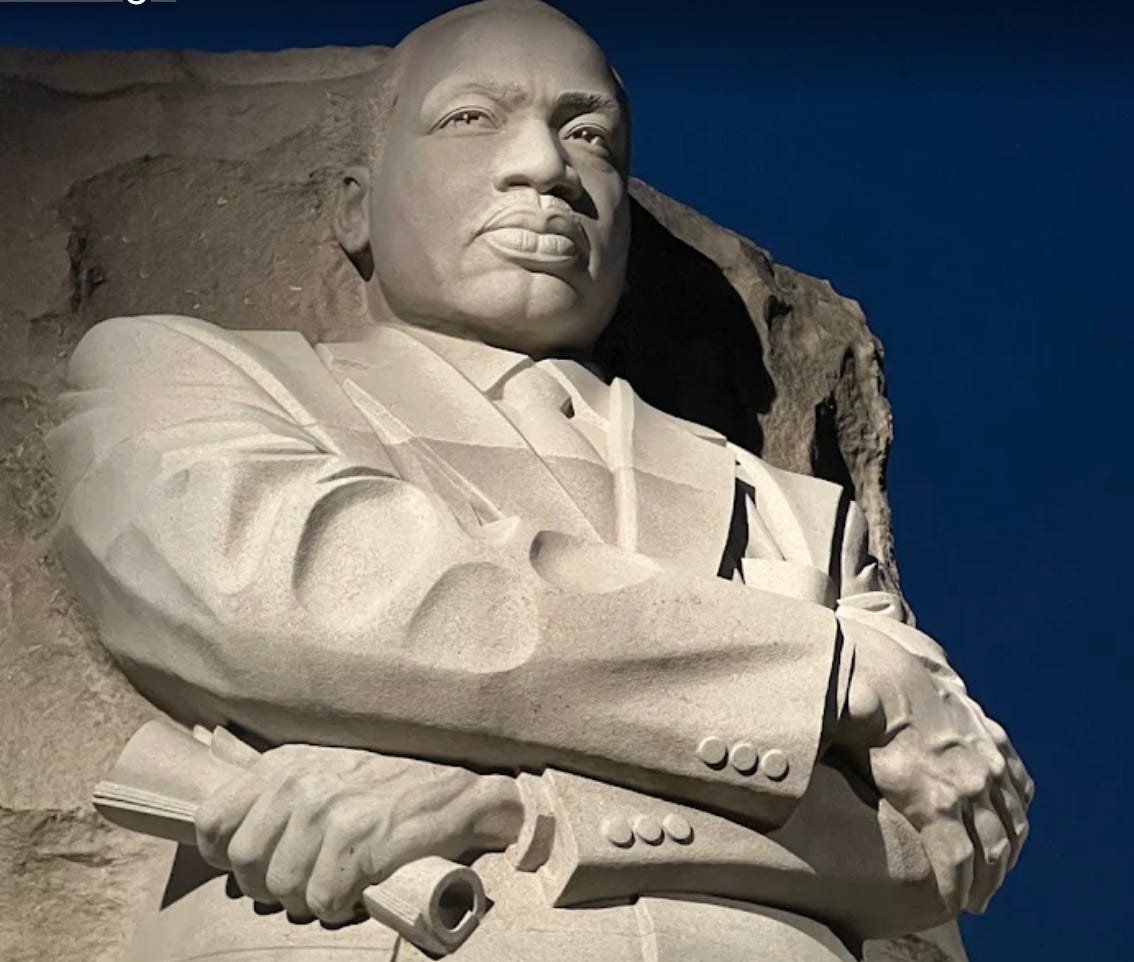
This past weekend, almost all of America marked Martin Luther King Jr Day. In his Nobel Peace Prize acceptance speech in 1964, Dr King concluded:
“I think Alfred Nobel would know what I mean when I say that I accept this award in the spirit of a curator of some precious heirloom which he holds in trust for its true owners – all those to whom beauty is truth and truth beauty – and in whose eyes the beauty of genuine brotherhood and peace is more precious than diamonds or silver or gold.”
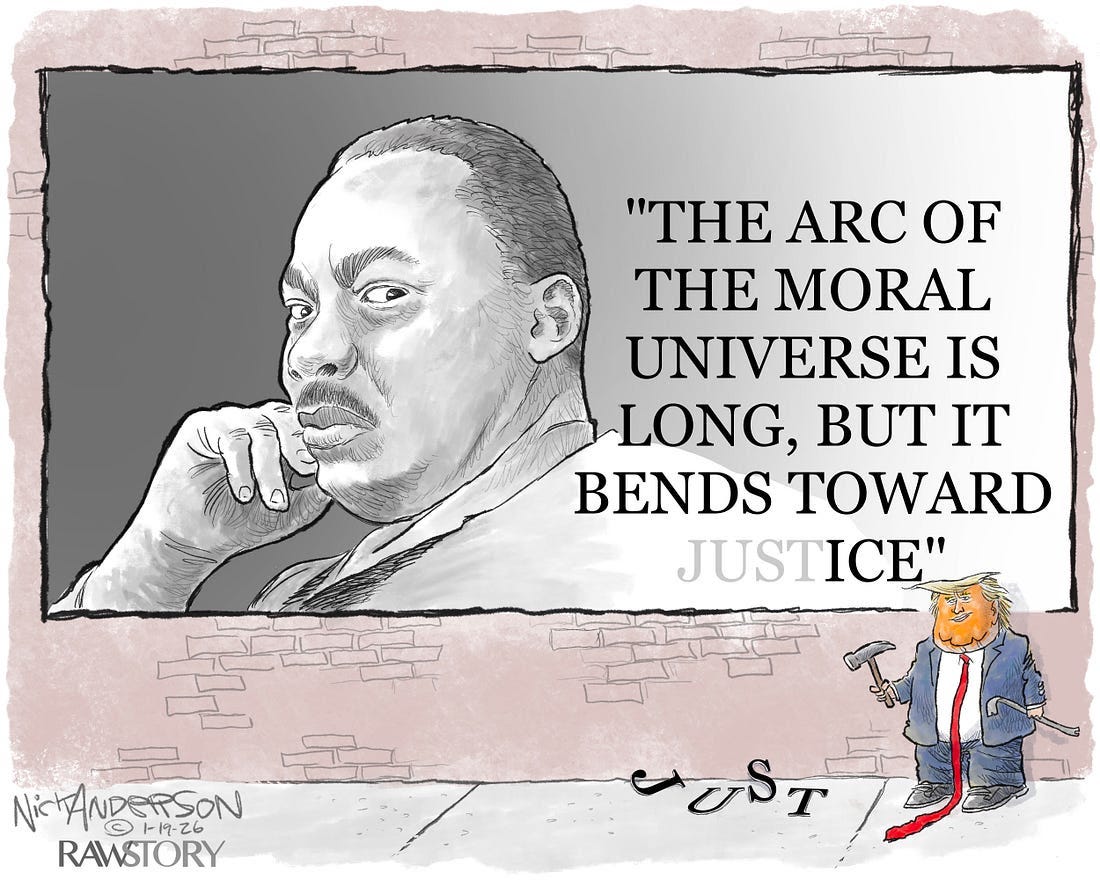
Today also sees one year since Donald Trump moved back into the Oval Office.
As M Gessen writes at the New York Times, frankly, “Who can keep track?”. Politico, meanwhile, points out some of the smaller but still significant things that may have flown below our collective radar.
Both at home and on the global stage, the effect of the chaotic past twelve months may have, for many of us, just progressively become too much. What Iker Seisdedos at El Pais described as a “runaway carousel… hurtl[ing] along in what often seemed like an eternity, lurching from one mood swing to another, threats, a climate of vengeance, exaggerations and lies, insults and tasteless jokes.”
As Charlie Sykes says in a piece called Full Mad King, “Unhinged” doesn’t really capture this moment.
“Yet here we are, trapped in a world be-shitted by this infantile man’s insecurities, delusions, and recklessness.”
Now, amid falling approval ratings on immigration – still the signature issue for energising Trump supporters – his administration’s assault on the people of Minneapolis continues, with 1,500 troops on notice for possible deployment , even though the president appeared, for now, to back off his threat to invoke the Insurrection Act.
Instead, as with previous reprisal prosecutions we’ve seen this year, Trump seems to have again turned to the legal system to target his perceived enemies, with his DOJ launching criminal investigations into Minnesota Gov Tim Walz and Minneapolis Mayor Jacob Frey.
Harry Litman at Talking Feds says the pretext for the probe is “so thin as to be transparent” and outlines five distinct forms of corruption within this move and why its precedent matters.
“The legitimacy of the Justice Department rests on the fundamental premise that its extraordinary powers may be exercised only to pursue provable crimes, not to coerce political outcomes. The investigation of Governor Walz and Mayor Frey inverts that premise. It deploys the most fearsome tools of the federal government in response to lawful political speech, while stretching a criminal statute past recognition to manufacture exposure.”
Charles Homans wrote for the New York Times Magazine at the weekend on why Trump’s fight with Minnesota “is about more than immigration.”
“One of the core themes of Trump’s politics,” Homans writes, “which has become the overwhelming argument of his second term,” is that
“..the country’s foundational idea of a civic nation — one whose people are bound by a shared commitment to principles rather than ancestry or cultural identity — is a sort of liberal swindle. In Trump’s America, shared prosperity requires exclusion: a policing, by force if necessary, of the boundaries of who gets to call themselves American based in large part on where they come from.”
ICE, meanwhile, continues with its often ugly activities. This, by Marisa Kabas, is the story behind one of the more disturbing images of the weekend. One neighbour said, simply: “Whatever you think it is, it’s worse.”
The fifth city to be targeted for a performative anti-immigration show of force, Minneapolis and its immigrant communities feel like they’re living through – as Tom Bateman writes for the BBC – “a battle of wills between a Republican president pressing the boundaries of his power and a Democratic city and state pushing back.”
See Also:
Pretext And Provocation, With Little Pretense
Disconnected (From November)
Peace On Earth (From December)
**
Make America Go Away
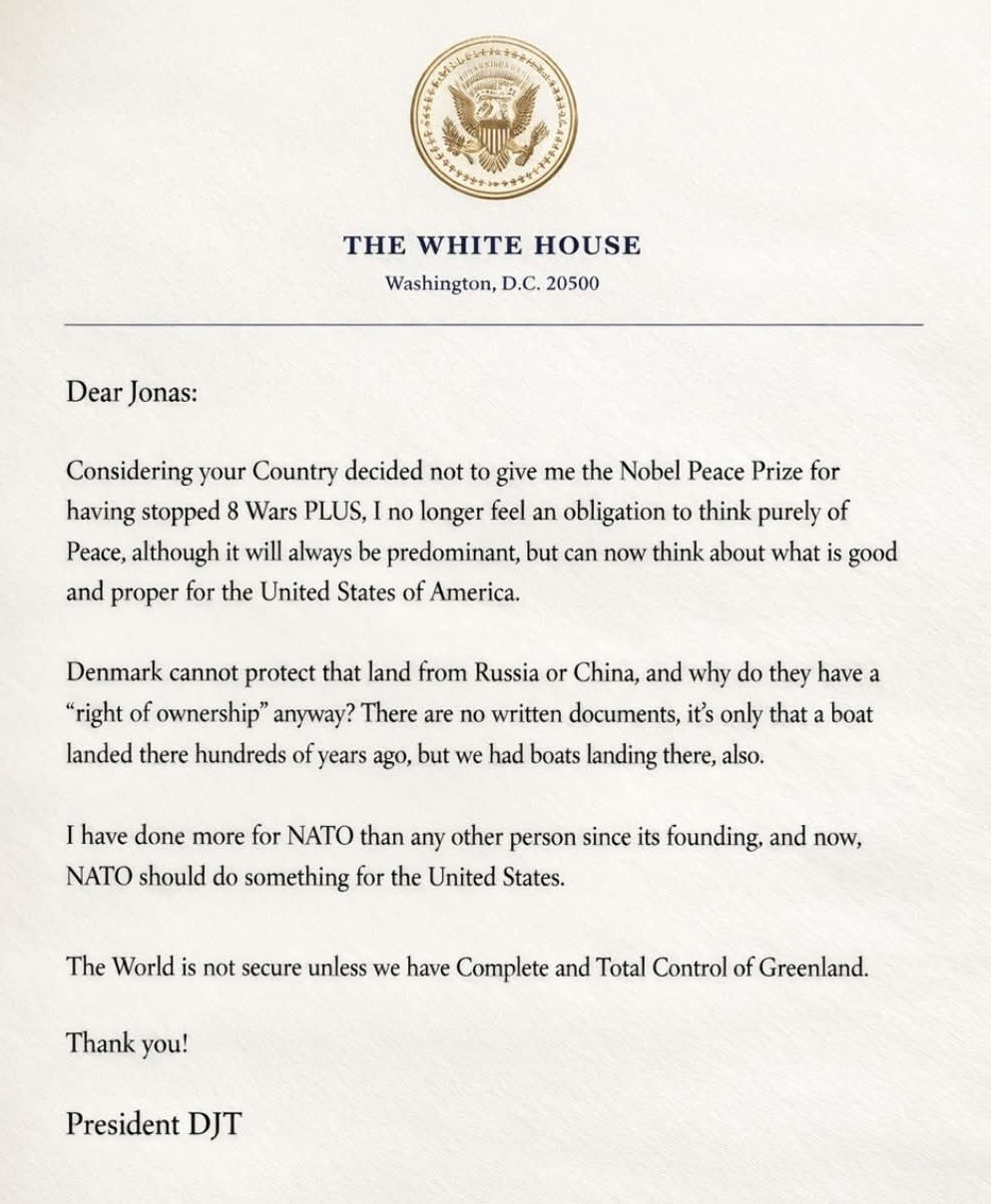
It was, actually, real. In a simply remarkable letter on Monday to the Norwegian Prime Minister, Donald Trump said that Norway’s decision (which it was not, of course) to pass him over for the Nobel Peace Prize contributed to his pursuit of Greenland and that he “no longer feels obliged to think purely of peace”.
At the weekend, Trump threatened to impose a 10 per cent tariff on EU member countries on Feb 1st – rising to 25 per cent unless an agreement for him to take “total” control of Greenland was not reached by June 1st. He also declined to say whether he might use force to take over the Arctic territory.
There were protests in Copenhagen at the weekend while thousands – pretty much everyone who lives there – rallied in Nuuk, the capital of Greenland, against Trump’s aggressive bluster towards their community.
But Europe isn’t taking the threats lying down and is considering an ‘anti-coercion instrument’ which would give it greater leverage in any escalating trade dispute. Trump’s recent actions have also forced the EU to rethink its own collective security strategy to face up to the US’s own, which recently prompted Moscow to gush that it was “aligned” with the Kremlin’s aims.
As the aforementioned Charlie Sykes recommends, Robert Kagan’s excellent, detailed piece ‘America vs The World’ at The Atlantic sets the historical context for understanding where the US and its allies will find themselves as the post-WW2 order disintegrates.
“The consequence of a newly unreliable and even hostile United States, therefore, will likely be significant military buildups by former allies. This will not mean sharing the burden of collective security, because these rearmed nations will no longer be American allies. They will be independent great powers pursuing their own strategic interests in a multipolar world. They will owe nothing to the United States; on the contrary, they will view it with the same antagonism and fear that they direct toward Russia and China. Indeed, having been strategically abandoned by the U.S. while suffering from American economic predation and possibly territorial aggression, they are likely to become hotbeds of anti-Americanism. At the very least, they will not be the same countries Americans know today.”
We appear to be pretty much back to where we were in Trump’s first term – they’re laughing their asses off in Moscow, but not for the reason he thinks – with Trump seemingly determined to divide the US from its allies while its adversaries simply can’t believe their luck. And as for his proposed ‘Board of Peace’, well, its underlying rationale may have become clearer this week.
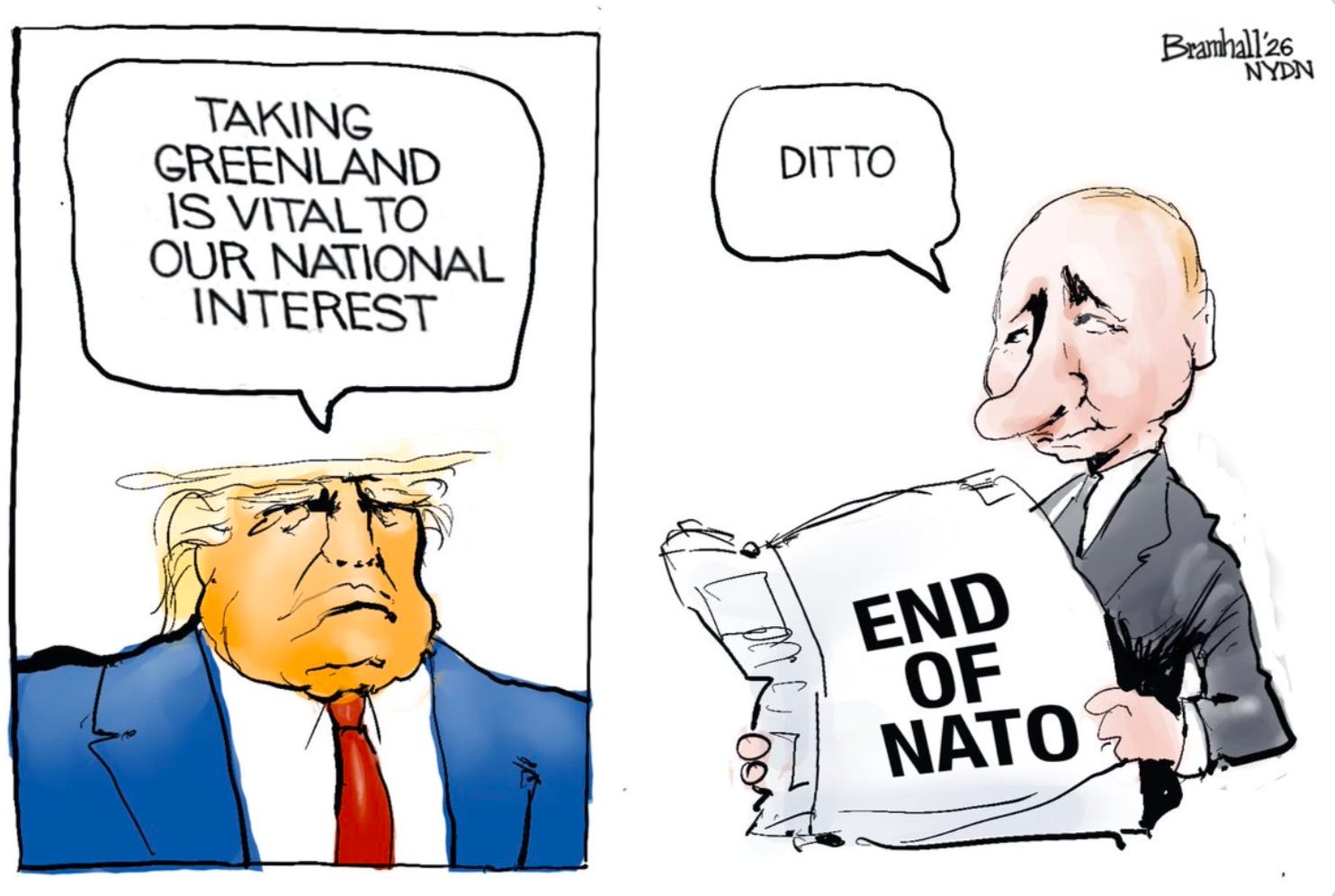
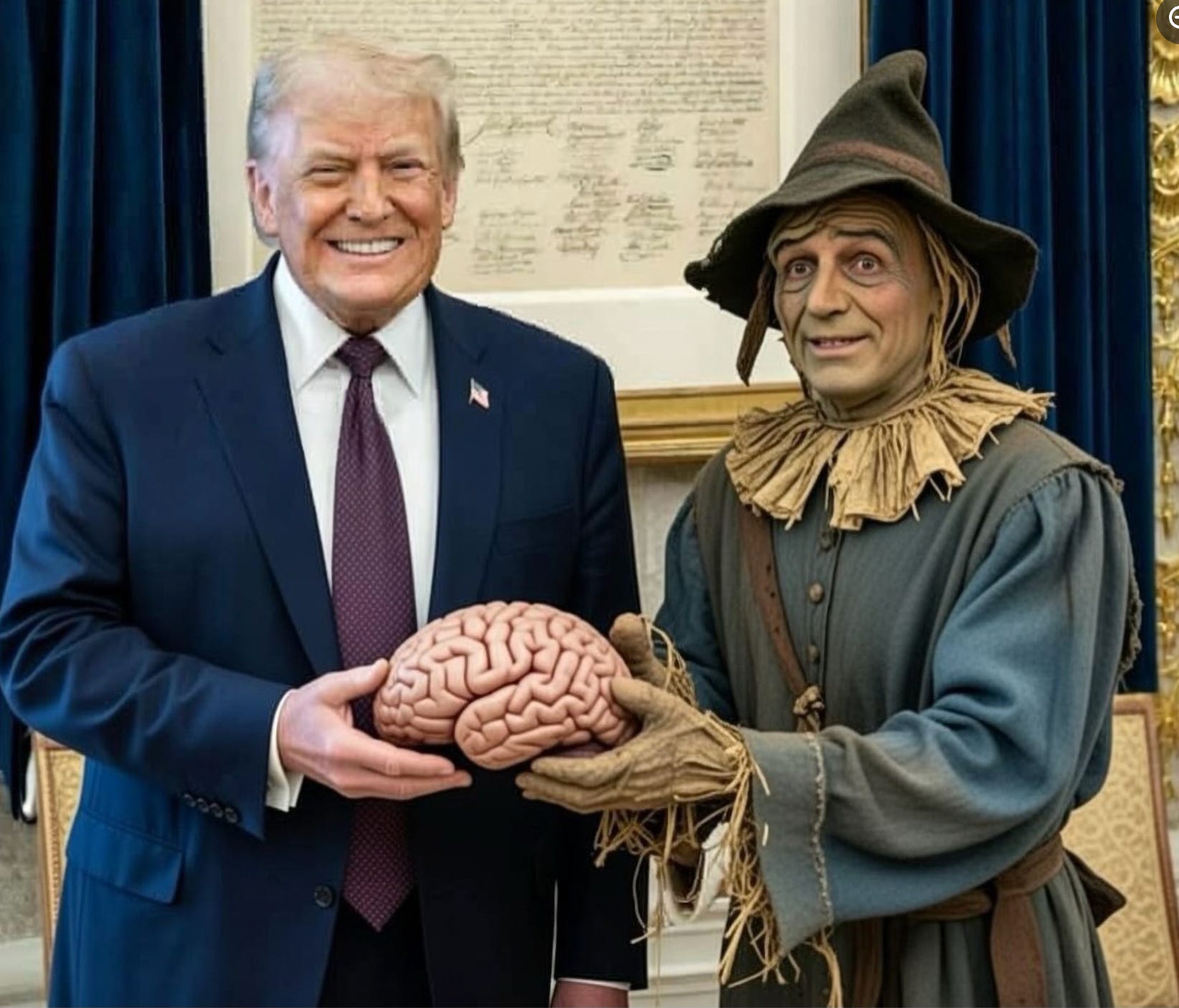
And if they’re laughing their asses off, it’s only fair we should too. The memes generated as a result of the completely bizarre scene last week when Trump was presented with someone else’s Nobel Peace Prize – grinning, as one pundit put it, “like a five-year-old getting a T-Ball participation trophy” – were inspired. I think this one, as most, anonymous, was my favorite.
See Also:
Nice Country You’ve Got Here (From March)
You Can’t Spell Tariffs Without FFS (From July)
Some Men Just Want To Watch The World Burn (From April)
The Only Restraint Is ‘My Own Morality’
‘Once In A Generation Moment’ (From February)
**
Wrapped In The Flag
Finally, circling back around to Trump’s preoccupation with the armed forces, the president pledged this week to sign an executive order stipulating that the annual Army-Navy football game should be the only one to be broadcast in a four-hour window, restricting competing games from the airwaves.
Despite Trump’s excessively patriotic defence of the game, though, having a window effectively free from competition with other games would be a huge bonus for one of his political allies. As CNN reported:
“The move would be beneficial to Paramount Skydance-owned CBS, which has exclusive rights to the Army-Navy Game through 2038. Paramount is led by CEO David Ellison, with backing from his father, billionaire Oracle co-founder Larry Ellison, who has forged close ties with Trump’s inner circle.”
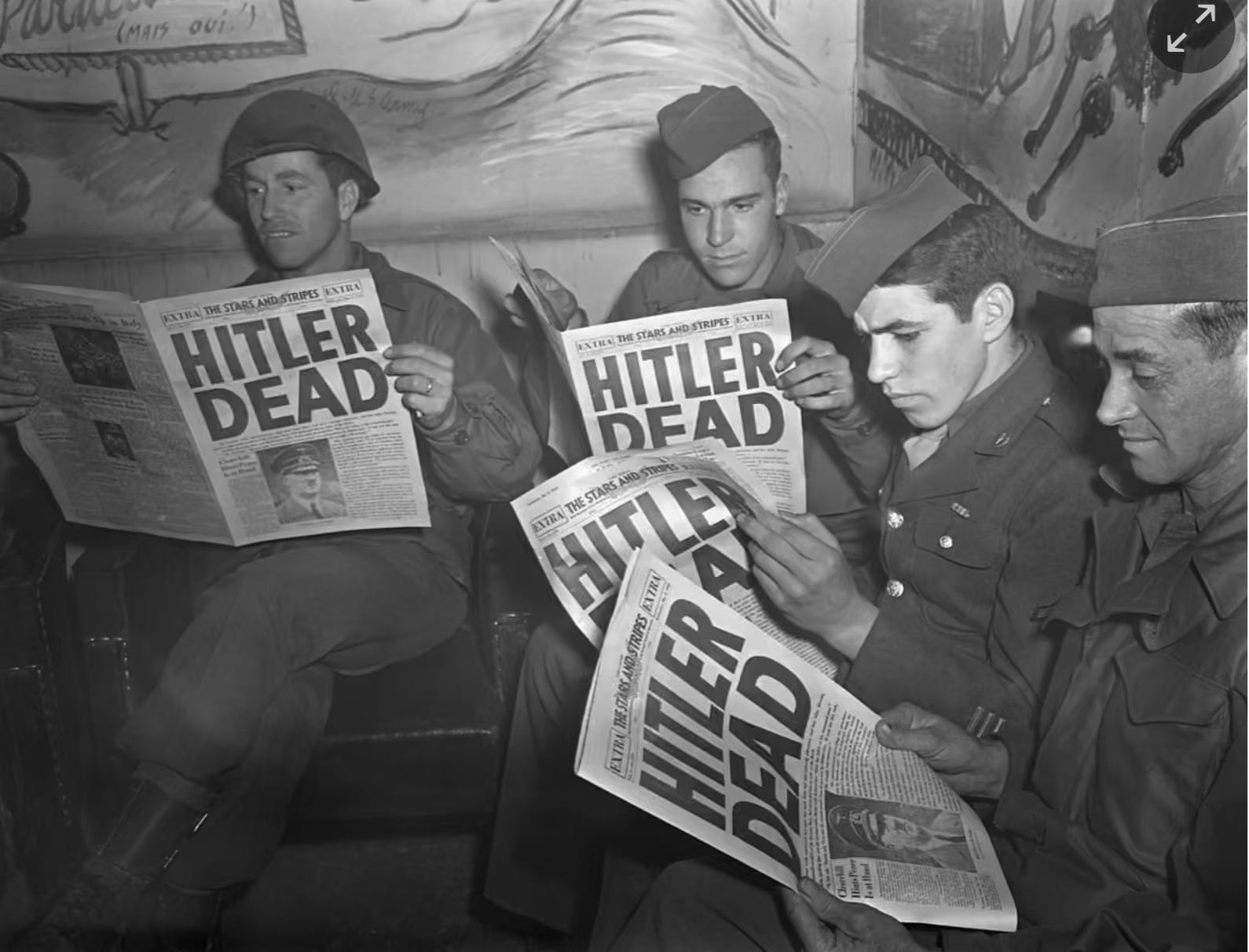
Meanwhile, the Pentagon this week said it would move to take control of Stars and Stripes, and overhaul the military newspaper to “refocus its content”. The Washington Post reported that job applicants at the paper “are being asked how they would support the president’s policy priorities, raising concerns among some staffers and media watchers about the prospects for the historic outlet’s editorial independence.”
See Also:
The Great Spiritizing (From September)
Regime Change (From December)
***
As always, thanks for reading. When I started this project in 2022, I simply did not think how wildly out of whack things in the political world would become; all while sports continue to show the face of a society functioning with what passes for “normality”.
As for how all of this ends – and what might come after – I have no idea. And if anyone tells you they do, they’re wrong. Unpredictability at home and abroad has become the touchstone of how we have decided to govern ourselves and there will be plenty of collateral damage before the dust clears.
The two links in the above paragraphs change with each weekly column – all the pieces are definitely worth reading. So far, they’ve been:
“Normality”
Donald Trump Suggests Re-naming NFL in ‘Football vs Soccer’ Debate, by Tom Gotti, in Sports Illustrated.
The State of Venezuelan Baseball is Strong, by Antonio Matheus, in Caracas Chronicles.
In a Year of Violent Tumult, the Sports World was Silent, by Dave Zirin, in The Nation.
Palm Beach Frozen Iguanas to make Class A baseball debut in 2026, in The Palm Beach Post.
Sports are an ideal home for Trump’s singular brand of ego stroking, by Andrew Lawrence in The Irish Times.
Dodgers go deep again by striking deal with Kyle Tucker, as much of the baseball world cries foul, by Steve Henson in the Los Angeles Times.
*
“What might come after”
Rebuilding America After Trump, by Pete Buttigieg, in The New York Times.
What Comes After Trump’s Age of Monsters? by CJ Polychroniou and Alexandra Boutri, in Common Dreams.
What will happen once Trump leaves office? It’s not good, by Dace Potas in USA Today.
Trumpism After Trump – The Future of the Right by Gladden Pappin and David Leonhardt, in The New York Times.
What comes after Trump? Turning Point USA endorses Vance amid party discord, by The Associated Press.
Donald Trump’s Golden Age of Awful, by Susan Glasser in The New Yorker.
*
During the regular season I aim to write a baseball-related post midweek and a politics wrap at weekends. As you might expect, one has been way more sane than the other.
You can find a full States of Play archive here.
I’m back to a roughly once-a-week post now throughout the off-season, when I’m hoping to feature some more Q&A write-ups and produce some new content for the site.
Let me know what you’ve enjoyed or what you haven’t? And if you think you might like to take part and talk about your memories of baseball and politics, drop me a line?
*
Just finished binge-watching Game of Thrones in all its spectacular goriness. One of the threads running through its 73 episodes is the desire to prevent Westeros from ever again being ruled by a mad King. If only the Founding Fathers could watch it now then harden constitutional protections preventing a tyrant from ruling in the Oval Office.