
Bullies
The ‘when I tell you to jump, you say ‘how high’ reality.

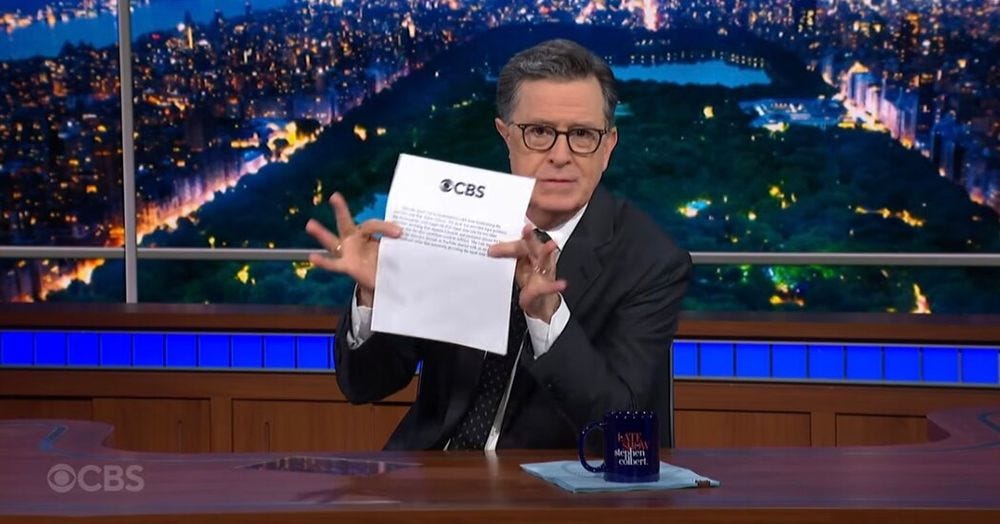
Stephen Colbert is all out of f*cks and it’s glorious.
The satirist, who will leave his Late Show stage on May 21 after more than a decade hosting the iconic CBS franchise, called out both the Tiffany Network and the Federal Communications Commission this week, saying he didn’t want an adversarial relationship with his employer but was “just so surprised that this giant global corporation would not stand up to these bullies.” He explains here:
Like a lot of this administration’s pronouncements, it usually devolves into something of a two-sided, nuanced situation, as Andrew Chang lays out for CBC News; but the undeniable outcome has been that moves by unabashed Trump loyalist Brendan Carr at the FCC to dictate on-air content appear to have completely backfired.
As of early Friday morning, the YouTube interview at the center of the row had clocked up eight million views (at least three times the number it would have got as part of the show), while James Talarico said his campaign had raised more than $2.5million in contributions in the first 24 hours, as online searches for his name skyrocketed.
Parker Molloy at The Present Age spells out how the spat fits within the recent CBS timeline and what it means.
“Colbert could defy his network’s lawyers on air, could say the thing they told him not to say, could draw Snoopy and call it James Talarico, because there’s nothing left for CBS to take from him. They already took it. What are they going to do, cancel it again?
“And the segment was good. It was genuinely funny and genuinely angry and it laid out the problem clearly enough that millions of people now understand what Brendan Carr is doing and how CBS is helping him do it. The YouTube interview got more attention than a normal Late Show booking ever would have. As an act of defiance, it worked.
“But Colbert is the exception. He can do this because he’s a dead man walking at his own network. What about everybody else?”
If you see this as part of a trend, you’re sadly right. Over the past year, media, law firms, universities and other institutions have all “capitulated with startling speed” according to many, including a former chair of the RNC, Michael Steele.
“Once you beholden yourself to a bully, you will always be bullied. It’s not a complicated narrative. In that regard, I’m not surprised by the ultimate outcome but I am surprised at the speed with which we’ve gotten there. Literally within six months of taking the oath of office, Donald Trump had pretty much slapped the crap out of everything and everyone he could and instead of fighting back they cowered in a corner.”
With no apparent resolution to the partial government shutdown over funding for the Department of Homeland Security, one of its components, the Federal Emergency Management Agency, has cut back on employee travel, including “some disaster response and recovery work”.
As the White House also instructed DHS to hunt for voter fraud by naturalized citizens, it emerged that DHS secretary Kristi Noem had sent several subpoenas to tech companies for information on “accounts that track or comment on Immigration and Customs Enforcement.”
Noem has been under pressure recently over her relationship with the Coast Guard – the only military branch DHS oversees – to say nothing of the controversy around her departmental mode of transport.
The administration’s intimidation, gaslighting, self-dealing and rubber-stamping now extends to the daily narrative on almost every topic, met often with a lack of pushback – this particular gish gallop about tariffs is sadly typical – while the so-called Fine Arts Commission appointed by Trump unsurprisingly approved the president’s plans for his White House ballroom which will be of course, larger than the White House itself.
And, oh yeah, this happened at the DOJ. Welcome to the new normal.
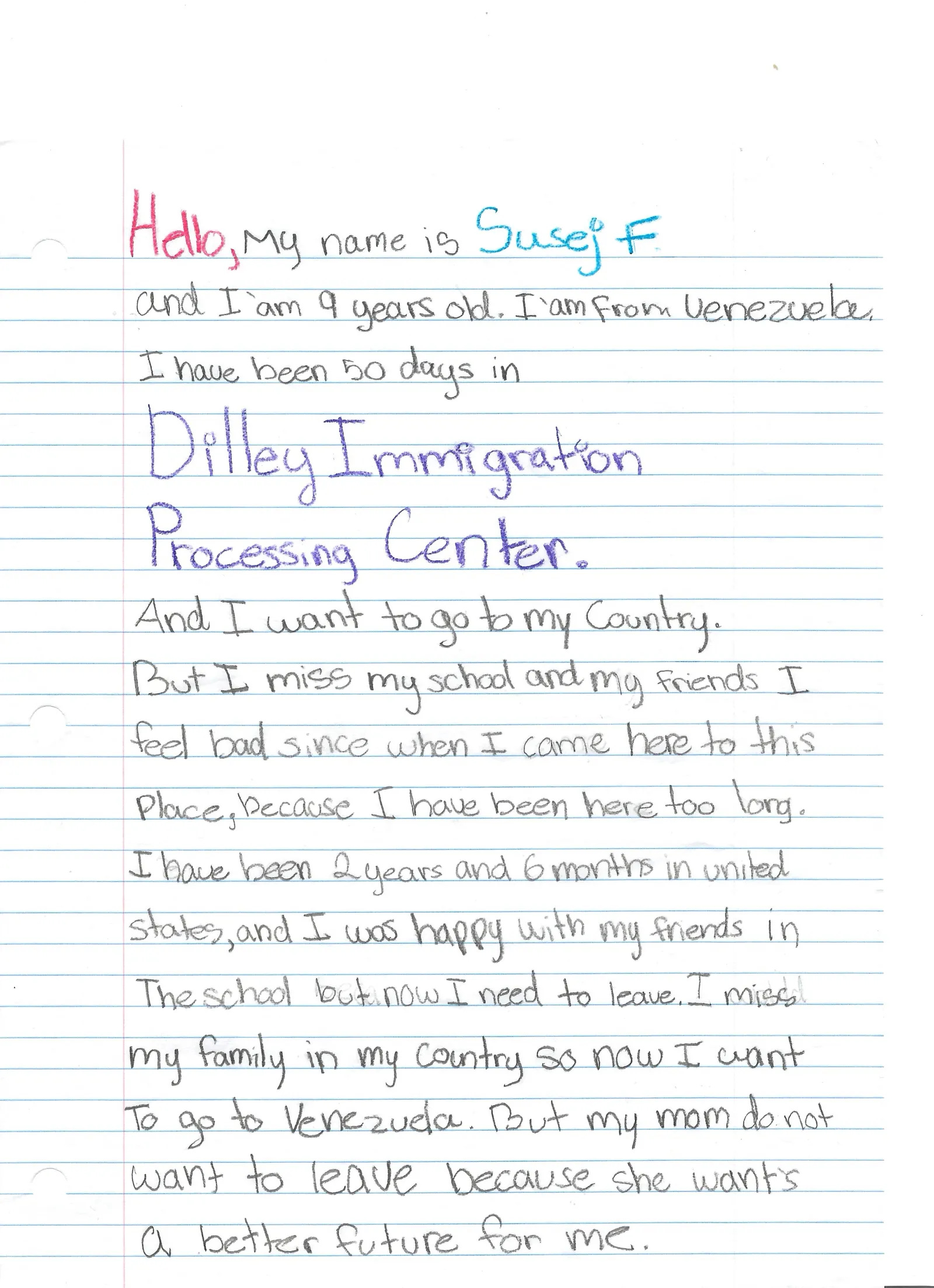
There is, however, little that is normal about the subject of a powerful investigation by Mica Rosenberg and colleagues for ProPublica about the hundreds of Children of Dilley – the “family” detention center in Texas. It’s a detailed and tough read, especially if you’re a parent. But it demands your time.
According to Reuters, on Wednesday, a federal judge in California threw out a decision by the Board of Immigration Appeals – overseen by DHS and DOJ – endorsing the Trump administration’s policy of subjecting thousands of people arrested during its immigration crackdown to mandatory detention.
The judge “criticized DHS for repeatedly and inaccurately suggesting that operations by U.S. Immigration and Customs Enforcement were limited to targeting criminal non-citizens who were the “worst of the worst.”
“Maybe that phrase merely mirrors the severity and ill-natured conduct by the government,” Sykes wrote. “Even though these press releases might contain an inkling of truth, they ignore a greater, more dire reality.”
See Also:
Powerful Performance, Performative Pique
‘The Easy Way Or The Hard Way?’ (From September)
A Real Shutshow (From October)
The Buck Stops Somewhere Else (From Feb 2025)
**
No-One’s Above The Law?

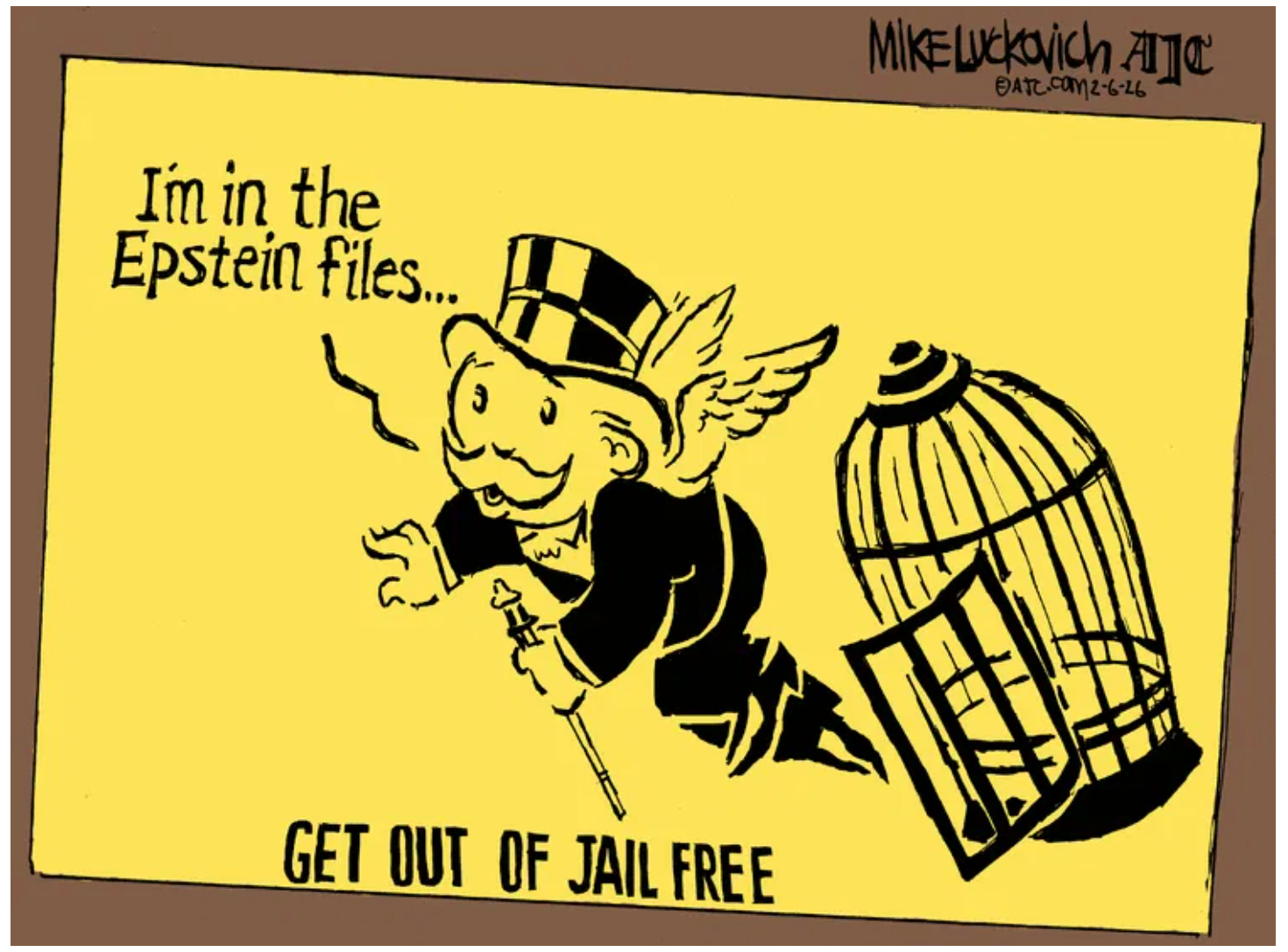
In a week where the UN Human Rights Council reported that the alleged acts in the Epstein Files could “meet the legal threshold of crimes against humanity,” the increasingly obvious contrast between the US and the rest of the world over their respective approaches to the scandal was highlighted by the first arrest of a member of the British Royal Family in the modern era.
In the US, as Helen Lewis observes at The Atlantic, Epstein is a sex scandal. Elsewhere, it’s a corruption scandal, but the former prince Andrew “acted as he did because he lived in a world in which someone like him never faced consequences.”
Andrew’s brother, King Charles, issued a statement containing one line that Donald Trump would be unlikely to ever say in such circumstances:
“Let me state clearly: the law must take its course.”
After Trump’s Attorney General Pam Bondi announced that somehow “all” the remaining Epstein files had been released, Trump – who is mentioned in the documents more than 38,000 times – insisted that he had personally been “totally exonerated”.
Steve Benen writes that “it’s worth pausing to appreciate the fact that the president has an unfortunate track record when it comes to this specific word.”
Rep Jamie Raskin, the ranking member on the House Judiciary Committee said, “‘I’m 100% exonerated’ will go down in history with ‘I am not a crook’ as one of the great criminal confessions of all time.”
Wednesday saw the deposition of billionaire Epstein associate and former Victoria’s Secret CEO Les Wexner, who appeared at his home in Ohio. No Republican lawmakers attended the session. The New York Times reported:
“In an opening statement he provided to the committee, Mr. Wexner, 88, described himself as “naïve, foolish, and gullible to put any trust in Jeffrey Epstein.”
“He added: “He was a con man. And while I was conned, I have done nothing wrong and have nothing to hide.”
“But Democrats emerged skeptical of anything that Mr. Wexner shared with them, calling him a lucid, competent witness who was simply not telling the truth.”
Separately, but hardly lost in any discussion of global accountability, South Korea’s former prime minister is beginning a life sentence in prison after being found guilty of leading an insurrection in 2024. The Guardian reports:
“The Seoul central district court found that Yoon’s declaration of martial law on 3 December 2024 constituted insurrection, carried out with the intent to disrupt the constitutional order.
“Judge Jee Kui-youn said the purpose was “to send troops to the national assembly to blockade the assembly hall and arrest key figures, including the assembly speaker and party leaders, thereby preventing lawmakers from gathering to deliberate or vote”.
(And, of course, Trump ally Jair Bolsonaro, the former leader of Brazil’s far-right, who was jailed in November last year for plotting a coup against the government in 2022, recently had an attempt to reduce his sentence rejected by the current president.)
See Also:
Forget The Files, Have You Seen The Dow?
Just The Tip (From December)
Trump Running Short Of Epstein Options (From November)
Back From The Dead (From July)
**
Nuclear Gulf
So, it appears Iran’s nuclear program wasn’t obliterated after all?
With talks on some kind of nuclear deal apparently “hanging in the balance”, as the US gathers the greatest build-up of air power in the region since the 2003 invasion of Iraq, President Trump appears to be gearing up for some sort of military confrontation with Tehran, but has so far been vague about exactly why.
As David Sanger writes at The New York Times:
“Though Mr. Trump is largely fixated on the nuclear weapons program, at various moments he and his aides have cited a range of other rationales for military action: protecting the protesters that Iranian forces killed by the thousands last month, wiping out the arsenal of missiles that Iran can use to strike Israel, and ending Tehran’s support for Hamas and Hezbollah…”
“Rarely in modern times has the United States prepared to conduct a major act of war with so little explanation and so little public debate. As Mr. Trump gathered the first meeting of the “Board of Peace” at the White House to discuss the rebuilding of Gaza, he veered briefly into the topic of imminent action in Iran, describing only the vaguest of objectives.
“They cannot continue to threaten the stability of the entire region, and they must make a deal,” he said, without describing the scope of that deal. “Bad things will happen if it doesn’t” strike that deal, he said, moving back to the topic of Gaza.”
Given the build-up of forces, The Washington Post reports, an attack could be possible within days, “despite the risks of U.S. combat fatalities and American ensnarement in an extended war.”
There has also been almost zero discussion or consideration of obtaining Congressional approval for any attack; but then I guess it didn’t matter last time either.
Meanwhile, amid the fallout from last week’s Munich Security Conference, Nathalie Tocci at The Guardian writes how Marco Rubio’s ‘reassuring’ speech to the Europeans was “nothing of the kind.” She writes:
“The secretary of state offered warm words, celebrating the shared cultural heritage, history and specifically the Christianity of the west. He claimed that the US, a “child of Europe”, was not interested in managing western decline but instead determined to spearhead a western civilisational renaissance.
“But beneath the surface, Rubio’s speech this year and JD Vance’s in 2025 were two sides of the same coin. Vance’s was crude and outrageous, even silly. At a time when there is democratic backsliding in most regions of the world, to claim that Europe’s biggest problem is a lack of free speech is simply ridiculous.
“Rubio’s speech was more subtle and coherent, but he in essence sang from the same hymn sheet: the message from Washington remains that Europe and the US should be defined by ethno-political values of culture, tradition and religion. The fact that such history has also bred nationalism, racism, fascism and colonialism is apparently nothing to be ashamed of.”
At The Atlantic, meanwhile, Thomas Wright argues that Rubio “doesn’t get it.”
“He told the audience: “We want allies who are proud of their culture and of their heritage, who understand that we are heirs to the same great and noble civilization, and who, together with us, are willing and able to defend it.”

It’s probably no surprise that Pope Leo decided against participating in Trump’s “Board of Peace” which held its first meeting in Washington on Thursday.
The Vatican’s top diplomat told reporters:
“One concern is that at the international level it should above all be the United Nations that manages these crisis situations. This is one of the points on which we have insisted.”
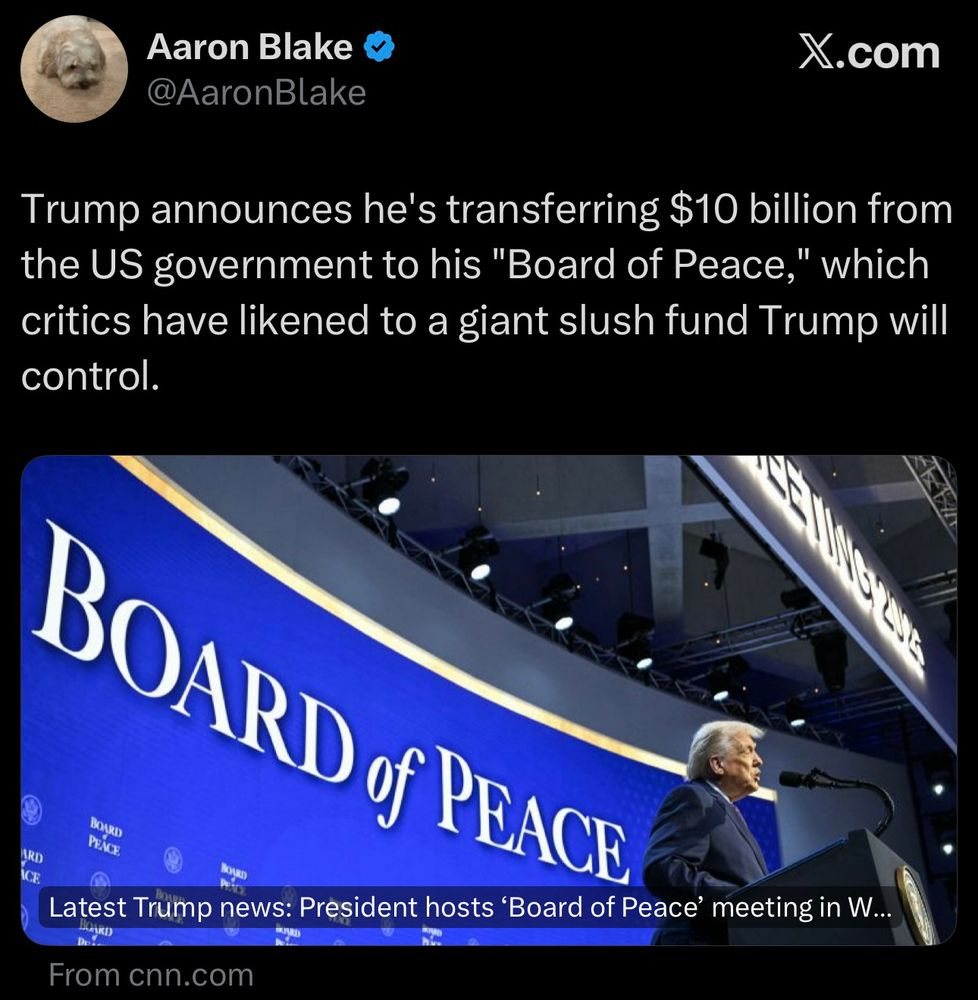
Trump, meanwhile, announced that the US would “contribute $10billion” to his ego-driven entity, with no indication of where the money would come from and hazy-at-best ideas of what it might be used for.
According to The Washington Post:
“Trump has framed the board as a supplement — or possibly an alternative — to the United Nations, which he has dubbed an ineffectual organization and put at risk of imminent fiscal collapse by withholding the United States’ mandatory dues that make up nearly a quarter of its operating budget as well as other contributions.
“The meeting was held at the U.S. Institute of Peace, the congressionally established independent nonprofit that the administration seized last year and renamed after Trump, a move that is still the subject of litigation.”
See Also:
Peace On Earth? (From December)
‘Everlasting Consequences’ (From June)
The Only Restraint Is ‘My Own Morality’ (From January)
The Pope And Nellie Fox (From November)
**
The Devil Went Down
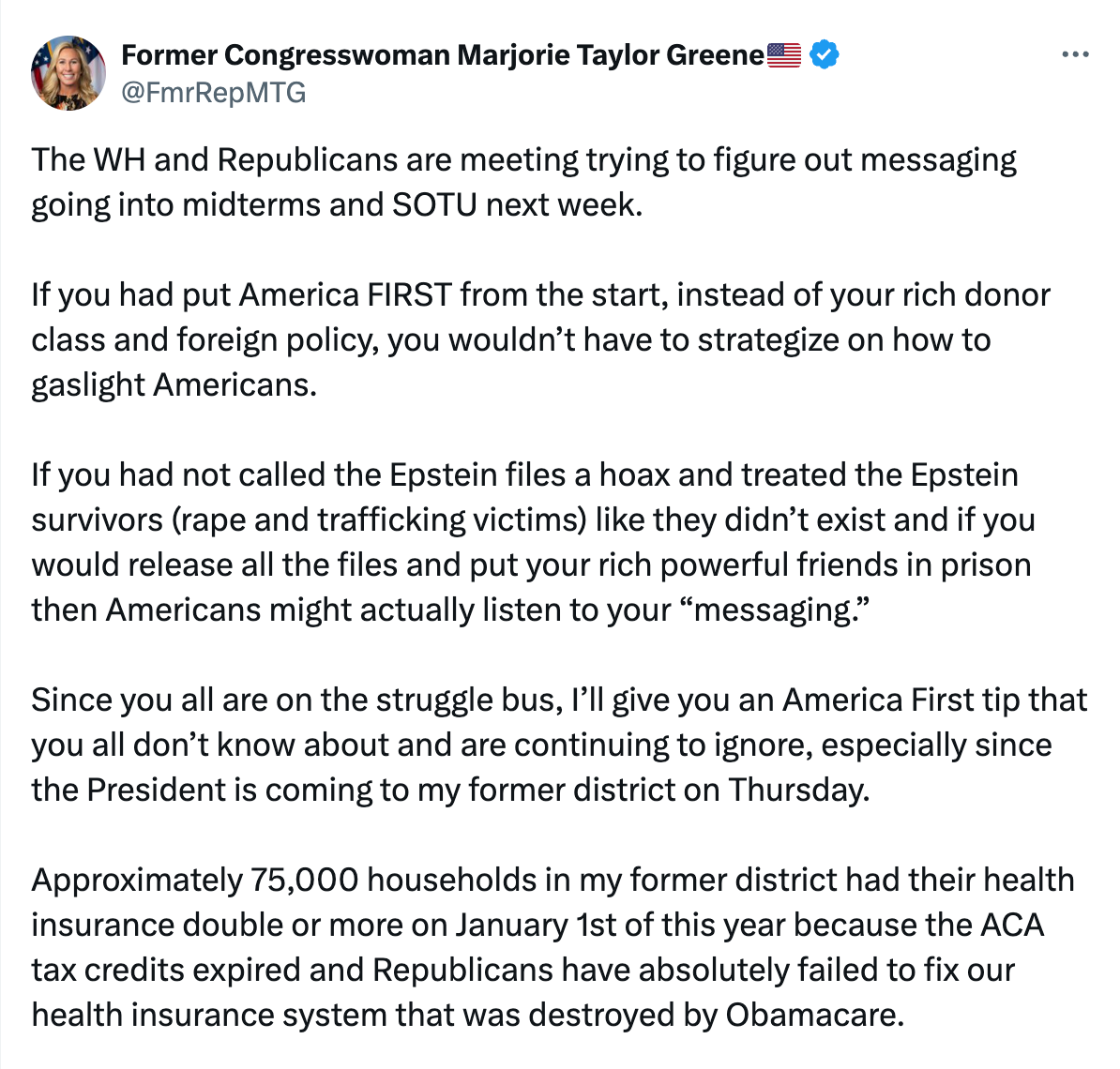
As early voting began in some key southern states, Donald Trump headed to Georgia ahead of its special election on March 10 to replace his former loyalist Marjorie Taylor Greene. He claimed to have “solved” the affordability issue before returning to his preoccupation with unfounded accusations that the 2020 election was stolen from him.
MTG herself couldn’t resist some advice:
The state’s Trump-aligned election board met for the first time since the FBI raided the Fulton Country electoral hub last month, and decided not to move to take control of the country’s elections – yet.
In Texas, Trump hasn’t yet endorsed – cautioned, perhaps by the recent Democratic victory in a deep-red state senate contest – in the Republican primary between 24-year sitting senator John Cornyn, who’s fighting for his political survival against AG Ken Paxton.
On the Democratic side, the tight primary between James Talarico and Jasmine Crockett has obviously been upended by the Colbert-related events of this week at the top of this newsletter.
In Kentucky, Rep Thomas Massie has been a thorn in Trump’s side particularly over the Epstein issue, and the president has already said he would support Massie’s opponent. In an interview with Politico this week, Massie warned the GOP that he believed there would be “more defections.”
With the House passing the controversial SAVE Act requiring voter ID – which is unlikely to pass in the Senate, but which the president has threatened to impose via Executive Order – Michael Tomasky at The New Republic writes that the measure is Trump’s “gravest attack on democracy yet.”
Many believe Trump is conditioning the country for uncertainty over the outcome of the midterms.
Katie Rogers writes at The New York Times that “Mr. Trump has always ramped up his efforts to cast doubt on the integrity of elections when he or Republicans he favors might lose. So far, ahead of a midterm election season where Republicans are fearful of losing the House — and perhaps the Senate, too — Mr. Trump’s latest pronouncements are right on time, and relentless.”
And with Trump openly telling troops at Fort Bragg recently that “you have to vote for us” or Kristi Noem talking about making sure “the right people vote”, it’s hard not to see some desperation creeping in.
(As we saw earlier, though, that’s hardly the only thing Ms Noem has to worry about right now.)
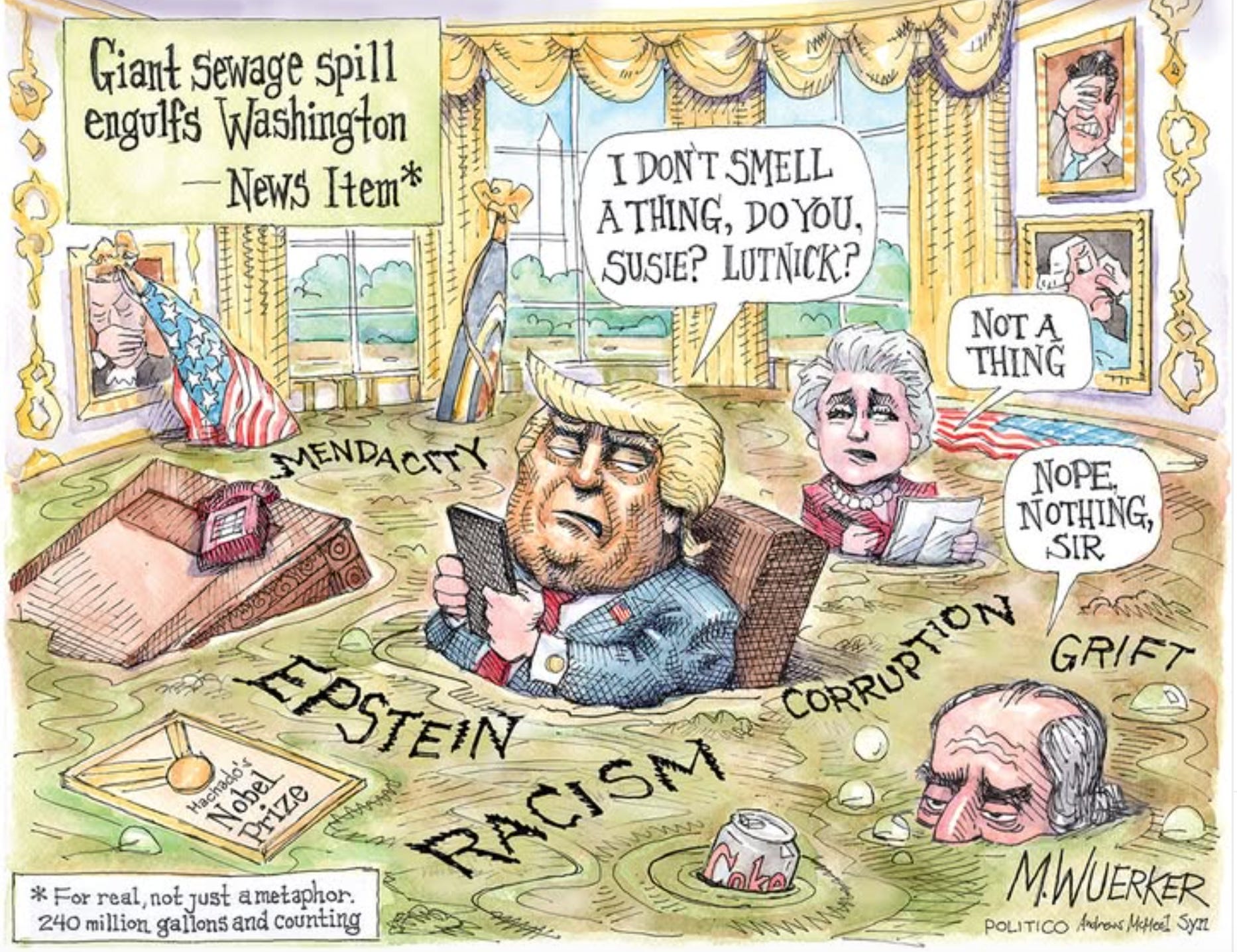
Finally, there’s a saying that someone who’s self-obsessed, superior and supremely arrogant believes that their “shit don’t stink”.
The problem for them is that everyone else is always aware of the stench.
See Also:
There’s More Than One Way To Win
**
Keep Hope Alive
Finally, the first presidential election campaign I travelled to the US specifically to write about was back in 1988 – roughly a quarter-century before I could vote in one.
I went to Iowa for their then-‘kingmaker’ caucuses and stayed with my good friend Chris Lamb as we braved the extreme cold, angry birds and Pat Robertson to travel around to various campaign events in the run-up to primary day. It was a fascinating trip that solidified my interest in US politics and political figures.
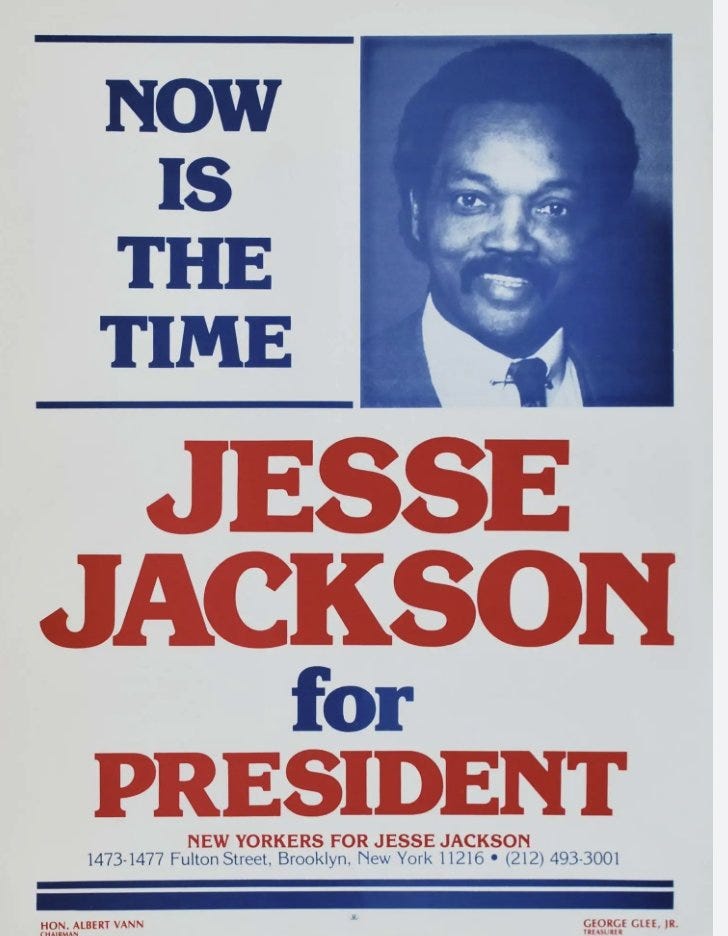
One of the best things about that campaign was watching the hugely charismatic Rev Jesse Jackson break though into the Democratic mainstream in a crowded field. He finished second in Iowa behind Michael Dukakis (who eventually won the nomination only to lose to Bush 41) but Jackson earned himself a hard-won seat at the policy table and a place in the Democratic party conversation for years to come.
Jackson’s groundbreaking progress within the party’s organisational structure eased the way for Barack Obama’s historic election twenty years later.
It was probably appropriate that a federal judge – appointed by George W Bush – this week ordered the Trump administration to restore slavery-related exhibits at George Washington’s former residence in Philadelphia, comparing their removal to George Orwell’s 1984.
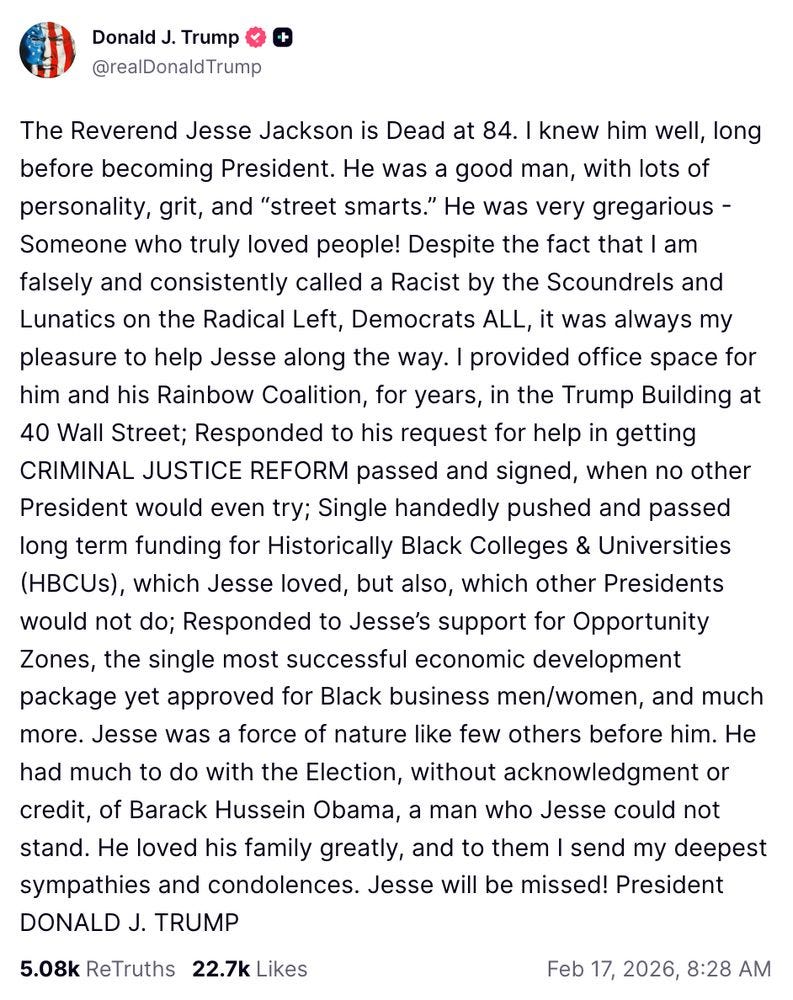
The current president this week couldn’t find anything bad to say about Jackson – even if he also couldn’t resist a predictable dig at Obama and make his ‘tribute’ all about himself.
Amid a remarkable life anchored in highly-effective political oratory, one of the most lasting visual memories of Jackson will be from 1972 and this appearance on Sesame Street.
RIP.
See Also:
The Impact On Other Lives (From April)
***
As always, thanks for reading. When I started this project in 2022, I simply did not expect how wildly out of whack things in the political world were about to become; all while sports continue to show the face of a society functioning with what passes for “normality” (and, indeed, weirdness).
As for how all of this ends – and what might come after – I have no idea. And if anyone tells you they do, they’re just plain wrong. Unpredictability at home and abroad has become the touchstone of how we have decided to govern ourselves and there will be plenty of collateral damage before the dust clears.
The two links in the above paragraphs change with each weekly column – all the pieces are definitely worth reading. They’re all linked here:
*
During the regular season I write a baseball-related post midweek and a politics wrap at weekends. As you might expect, one has been way more sane than the other.
Last year, I began the separate posts the same week as Opening Day, but since players are now at their teams’ Spring Training sites – I’ll aim to start the baseball posts back up ahead of the beginning of the WBC, the first week of March.
(Already, though, we seem to be having the same “should the Dodgers go to the White House?” discussion as we did last year – especially with rumors that the Super Bowl champion Seahawks might not.)
Before the season starts, I’m hoping to organize some more Q&A write-ups and produce some new content for the site. You can, of course, find a full States of Play substack archive here, and the original site here.
Let me know what you’ve enjoyed or what you haven’t? And if you think you might like to take part and talk about your memories of baseball and politics, drop me a line?
*