
Get Out The Map
The face of Jim Crow under a bald eagle

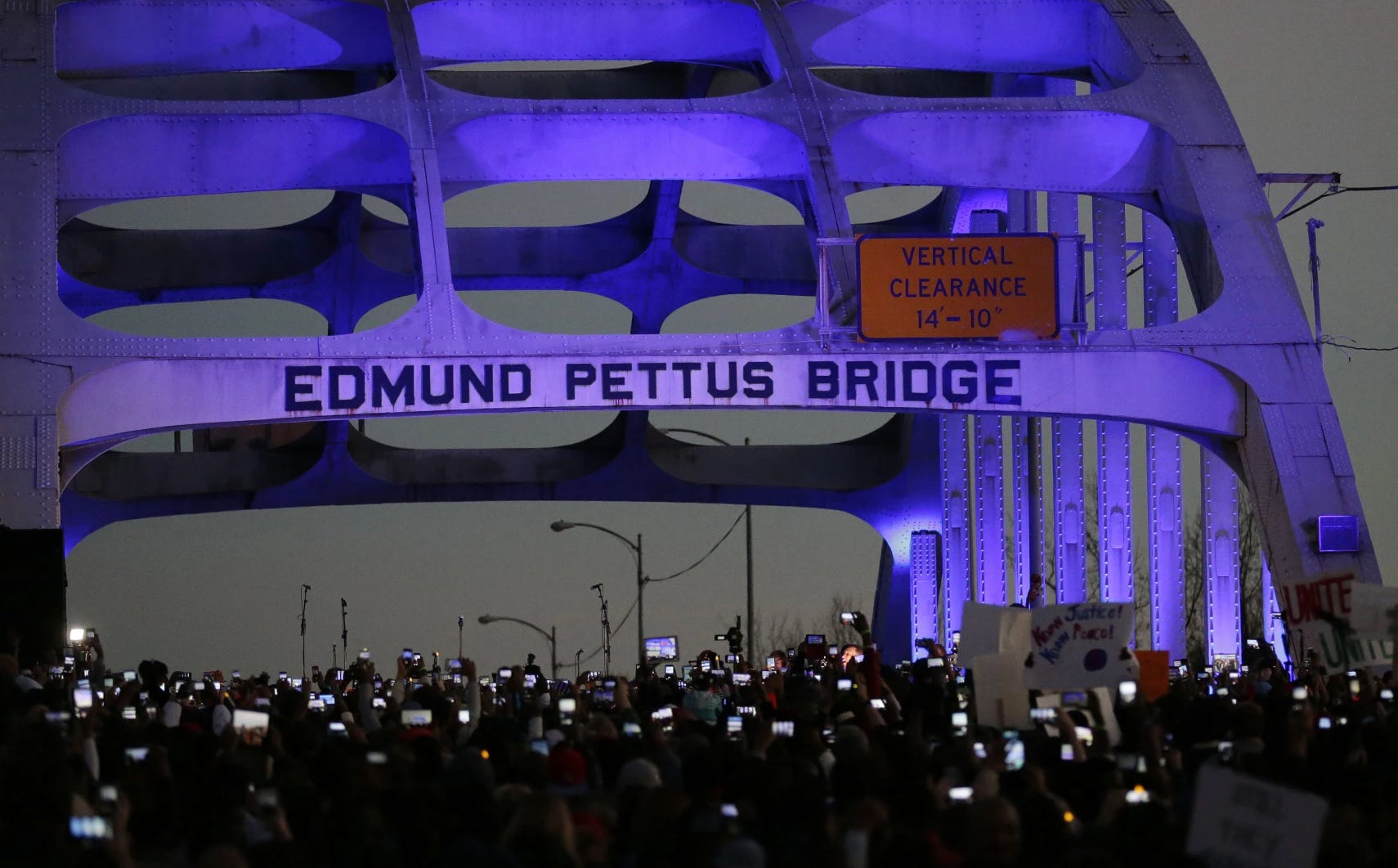
By now, it should be clear to most sentient Americans beyond Donald Trump’s core base that the president and his allies are well into plans for disrupting the upcoming elections to his advantage.
Thomas Edsall wrote at The New York Times on how Trump’s blinkered view of his own unchecked power could lead him to react to a “mortifying defeat” at the polls, under a headline from the president’s own mouth: “When you think of it, we shouldn’t even have an election.”
Edsall ends:
“When I first queried Kenneth Mayer, a political scientist at the University of Wisconsin-Madison, he replied by email with a largely technical examination of presidential powers. A few days later he added to his comments, writing:
“What I did not accurately convey is how Trump has obliterated the boundaries and guardrails that we had long thought would serve as meaningful constraints on presidential extremism.
“He is acting as if his will is law, the government and everything in it belongs to him, and everyone owes their allegiance to him, not to the Constitution, the law or the public good.
“What we are seeing now, Mayer concluded, “is not normal, is utterly corrosive to principles of constitutional and democratic governance and is extremely dangerous.”
Hugh Tomlinson wrote at The Observer that the impending electoral conflict is “one war Trump has planned down to the last detail”.
“The 2026 midterms are poised to be another stress test for American democracy. Determined to hang on to power at any cost, Trump is openly laying the ground to contest and subvert the will of voters under the pretext of defending it.”
Trump’s personal approval ratings continue to tank, driven mainly by his handling of the economy and his chaotic war against Iran. Yet despite a dramatic decline over the past three months, his support is still tracking around 35 per cent.
With the usual proviso that there is an unpredictable age to go until November, generic congressional ballot polling indicates a Democratic blowout of some proportion, even if the crucial possibility of registered voters not showing up as happened in 2024 could still prove a significant issue.
Meanwhile, Americans’ confidence that their elections will be run fairly has dropped to its lowest point in years, according to a recent poll reported by PBS.
Into this landscape of potential electoral turmoil, the Supreme Court dropped the Louisiana v Callais bombshell, a landmark ruling which severely restricts the – already restricted – Voting Rights Act of 1965.
Kevin Morris and Michael G Miller wrote at Slate on how history offers a guide to “how bad things are about to get.”
“Our work has shown that the court’s previous assaults on the act have wrought devastating consequences for voters of color. The impact of this decision likely won’t be different. Minority voters will now be left with a diminished voice in American politics, rolling back half a century of steady progress toward racial equality in voting practices.”
Louisiana’s Governor suspended an election that had already started so a redrawn map could be implemented, while a slew of other majority-Republican states rushed to break up Black-represented districts. Jonathan Shorman wrote for States Newsroom that the redistricting process is also likely to extend into the next presidential cycle.
“More states, in the South and elsewhere, are expected to pursue new maps over the next two years. Georgia Republican Gov. Brian Kemp ruled out a special session this year, for example, but supports redistricting before the 2028 election.
“The current moment represents an extraordinary time in America, said Rebekah Caruthers, president and CEO of Fair Elections Center, a nonpartisan voting rights group. But she also called it a reversion “back to America.”
“Many thought the presence of Black, Hispanic and Asian American elected officials somehow meant racial discrimination no longer existed, she said.
“And unfortunately, that is a misread of American history,” Caruthers said. “And perhaps it is a retelling of American history for those who want to gloss over America’s very sordid past, especially when it comes to voting rights.”
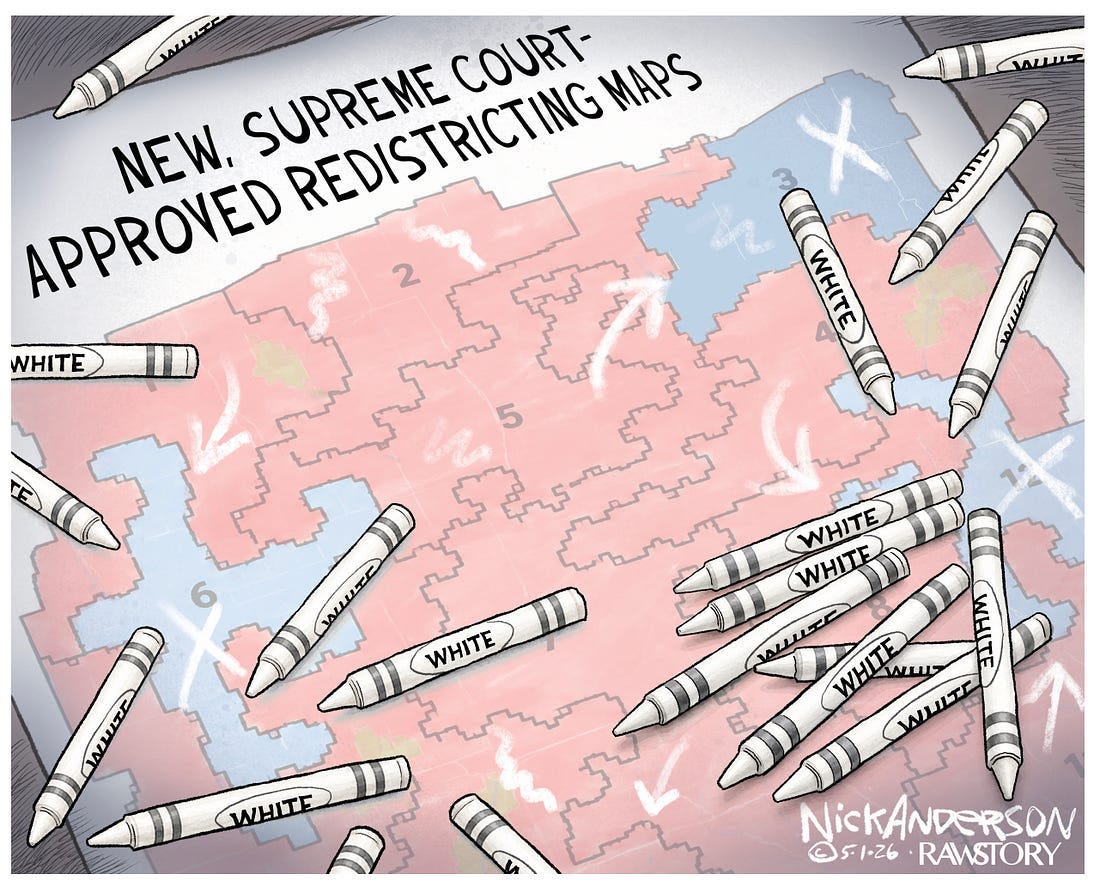
David A Graham wrote at The Atlantic how the Supreme Court “went from condemning partisan gerrymandering to effectively encouraging it,” while Sophia Lin Lakin – the director of the ACLU’s Voting Rights Project – wrote for The Guardian that “Some will celebrate this as a victory for a “colorblind” constitution. But ignoring racial discrimination does not make it go away; you cannot cure a disease by refusing to diagnose it.”
“This decision will jeopardize maps for congressional seats, state legislatures, city councils, school boards – every level at which communities of color have fought for true representation. Without section 2 [of the Voting Rights Act] as a meaningful protection, legislatures across the country will face far fewer legal constraints on drawing maps that dilute minority voting strength. Fair districts that took decades of litigation – not to mention blood and sweat – to achieve are now at risk.”
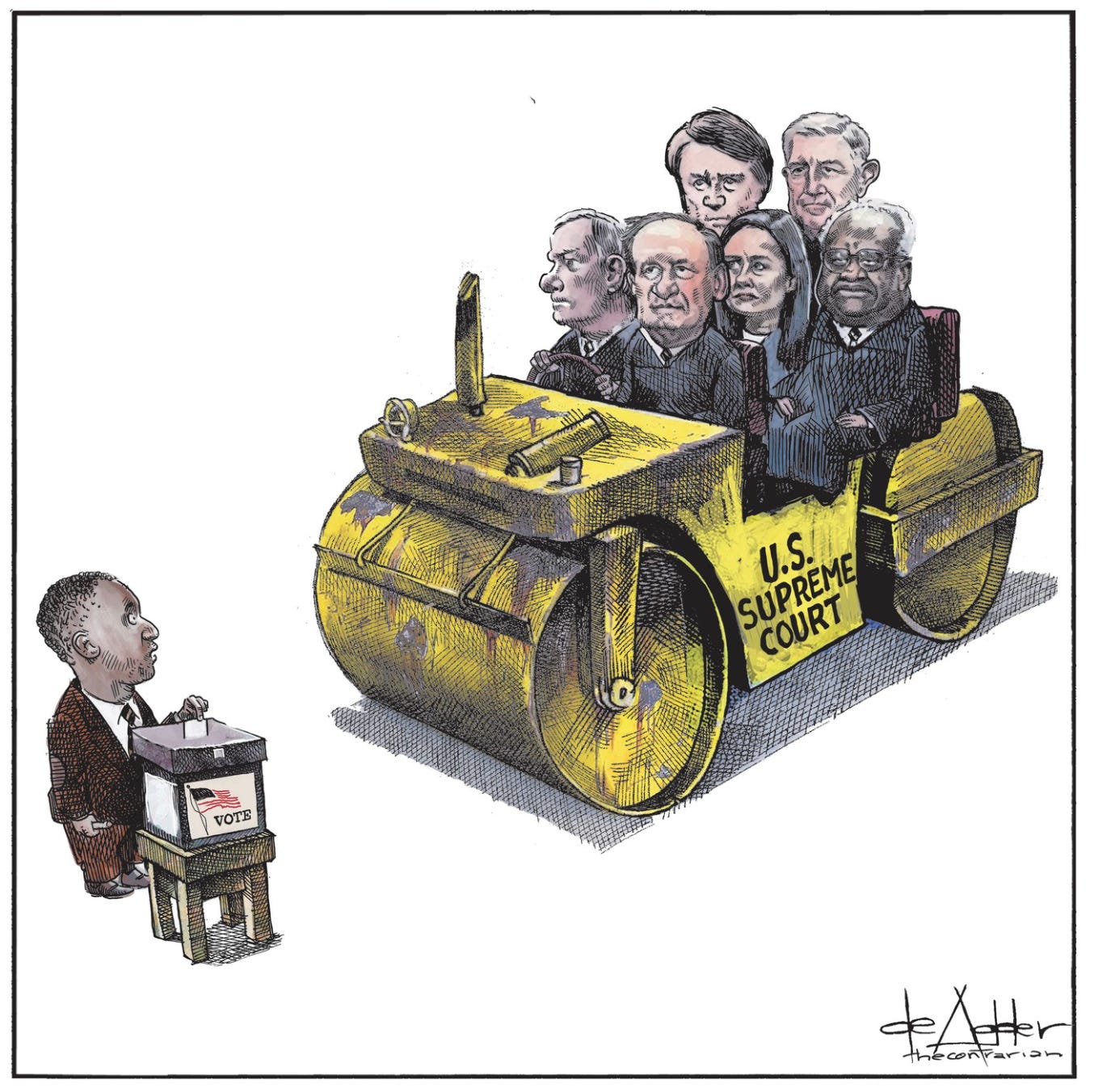
Ashleigh Maciolek writes about the man who today becomes the second-longest-serving Supreme Court justice ever, reminding us that:
“He was the only justice who voted to block the House committee investigating the January 6, 2021, insurrection from accessing records and documents — including messages from his wife that revealed her extensive efforts to overturn the election results.”
Meanwhile, despite continuing high-profile signs of cracks in the president’s MAGA coalition, Chris Stein writes at The Guardian that in Tuesday’s primaries in Indiana at least, Republican politicians still appear to have two choices – align with Trump or be ousted.
See Also:
There’s More Than One Way To Win (From February)
Vote While You Still Can (From November 2025)
Fight Fire With Fire Until The House Burns Down (From August 2025)
January 6th Riot ‘Doesn’t Happen Without Trump’
King And A Pretender (From January)
**
The Brain Fog Of War
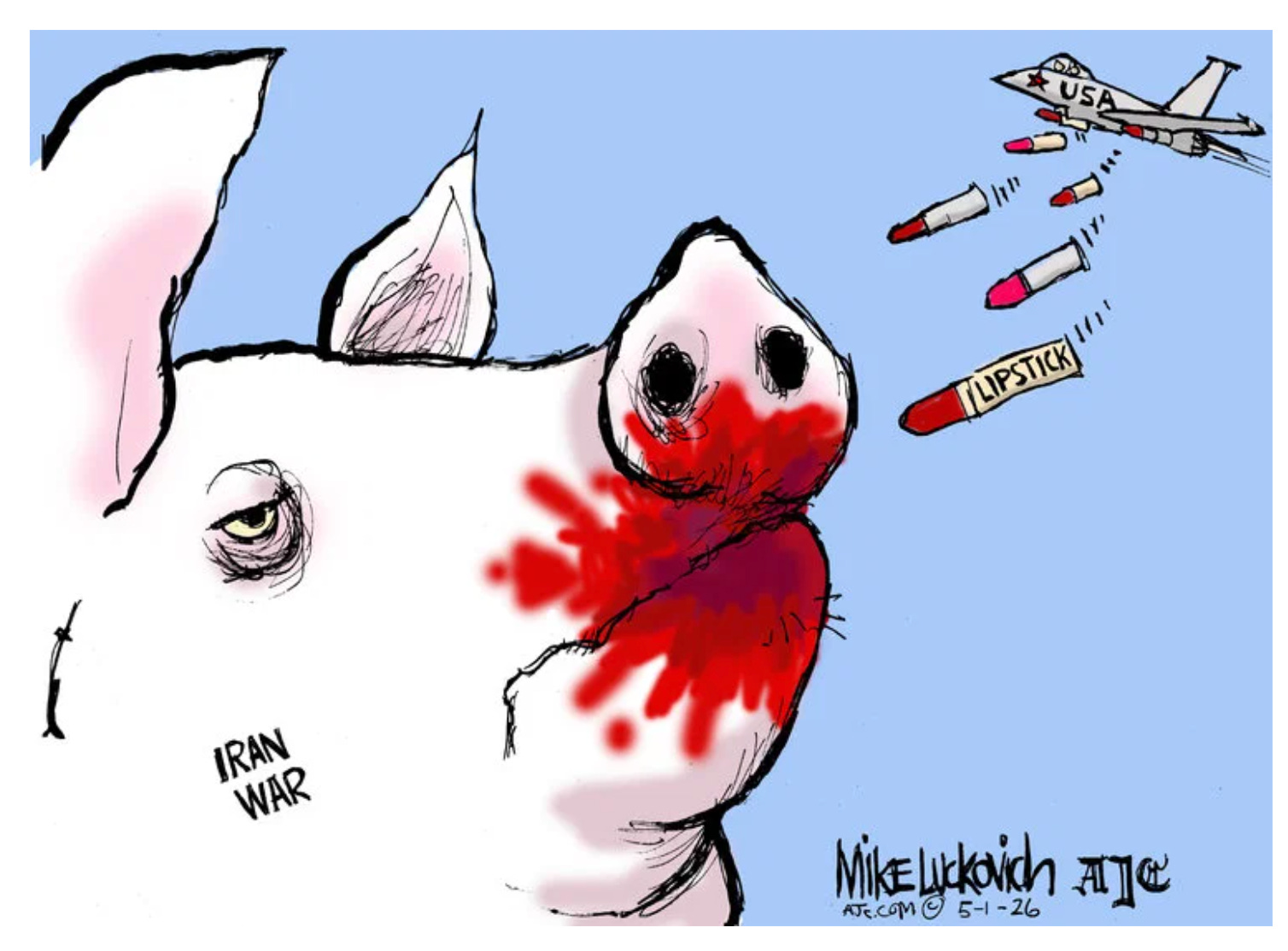
It’s hardly a great surprise that an administration that couldn’t agree on why its war against Iran started is having trouble articulating how it might end. Or indeed, whether it has, actually, already ended.
Within the space of the past 24 hours amid conflicting messages, President Trump said the war “would be over quickly” then that a deal was “very possible” while Iran downplayed negotiations, all amid a US threat to “resume bombing” if a peace deal wasn’t struck.
The AP reports:
“The Trump administration’s shifting and often contradictory messaging throughout the Iran war has produced ever more confusion this week as the president and his aides presented a dizzying narrative over the U.S. strategy to unblock the Strait of Hormuz and wrap up the war that drastically changed over the course of mere hours.
“Administration officials have been trying to walk a fine line between maintaining the ceasefire and reopening the strait, where 20% of the world’s oil normally flows. The economic fallout is growing as fuel prices rise, with Republicans facing increasing pressure to find solutions to higher costs ahead of the midterm congressional elections.”
While there was confusion over “kamikaze dolphins,” the American people appear to “overwhelmingly disapprove of religious rhetoric” surrounding how Trump and his Secretary of Defense Pete Hegseth talk about the war. This comes ahead of a meeting between Pope Leo and Secretary of State Marco Rubio today, following a fresh broadside by Trump against the Pontiff.
Somewhat more seriously, The Washington Post found that Iran “has hit far more US military assets than reported” according to satellite images.
“Experts who reviewed The Post’s analysis said the damage at the sites suggested that the U.S. military had underestimated Iran’s targeting abilities, not adapted sufficiently to modern drone warfare and left some bases under-protected.”
Earlier in the week, the first official estimates of the cost of the war were released. Excessive though they may have appeared, they were, predictably, way short of what others believe is the “true cost”.
Stephen Semler at Popular Information explains why there is such a wide discrepancy.
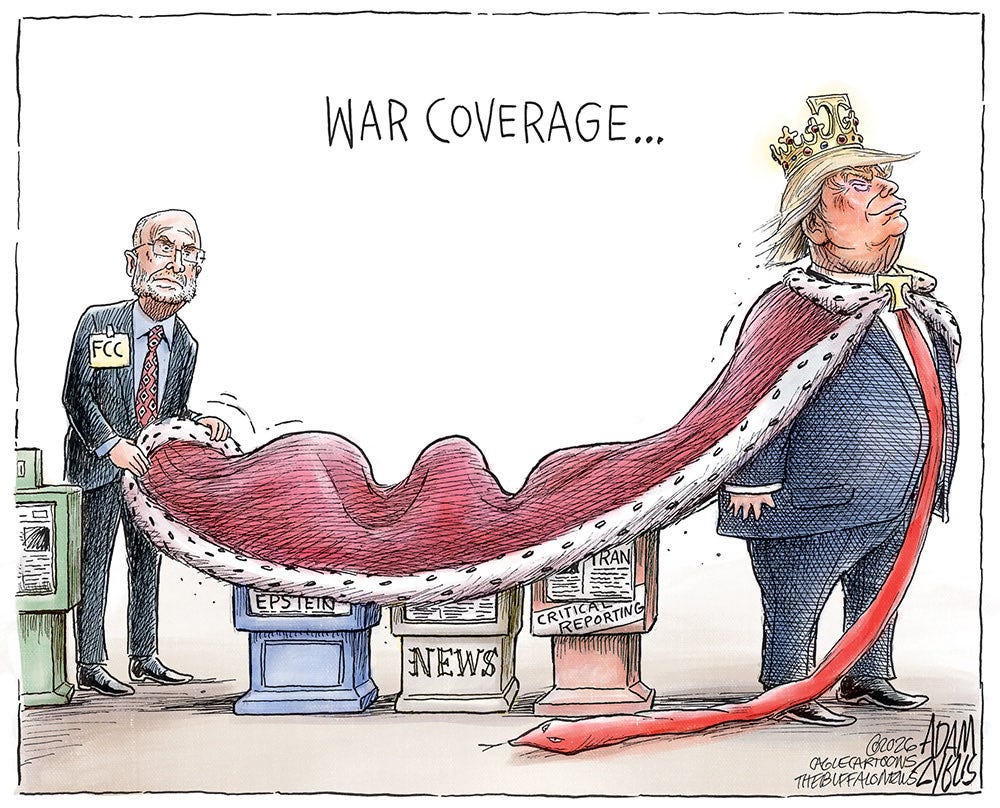
President Trump’s relationship with traditional European allies was further strained this week after German Chancellor Friedrich Merz’s remarks that Iran had been “humiliating” the US in negotiations to end Trump’s conflict of choice. Trump reacted by saying he would withdraw 5,000 US troops from Germany. That move apparently followed a phone call between Trump and Vladimir Putin about their respective wars.
With concern growing all across Europe over the wider impact of Trump’s war – and particularly over the still-unresolved war waged by Russia on Ukraine – it’s still not clear that Americans realise how much damage Trump has actually done to the reputation of the country among its former allies. It is not just at home that his approval rating has tanked.
But all is perhaps not lost. Patrick Wintour at The Guardian writes about how “the dark era of Trump is creating a new approach to global politics.”
“For millions of people, the head of the UN humanitarian programme, Tom Fletcher, said last week: “The international order is not on the cusp of collapse, it has already collapsed. What we are going through right now is not a drill.” Fletcher called for greater honesty about the scale of global upheaval and the need for a renewed seriousness in public life.
“This is because the way Trump and his fellow travellers have put an axe to international law has made the task of humanitarians near impossible. Indeed, humanity itself is under attack, Agnès Callamard, the secretary general of Amnesty International, said in presenting the human rights organisation’s 2025 report. She described 2025 as the year of the predators.”
See Also:
With Friends Like Those, Who Needs Enemas?
A Blood Red Carpet (From August 2025)
**
The Billion-Dollar Ballroom
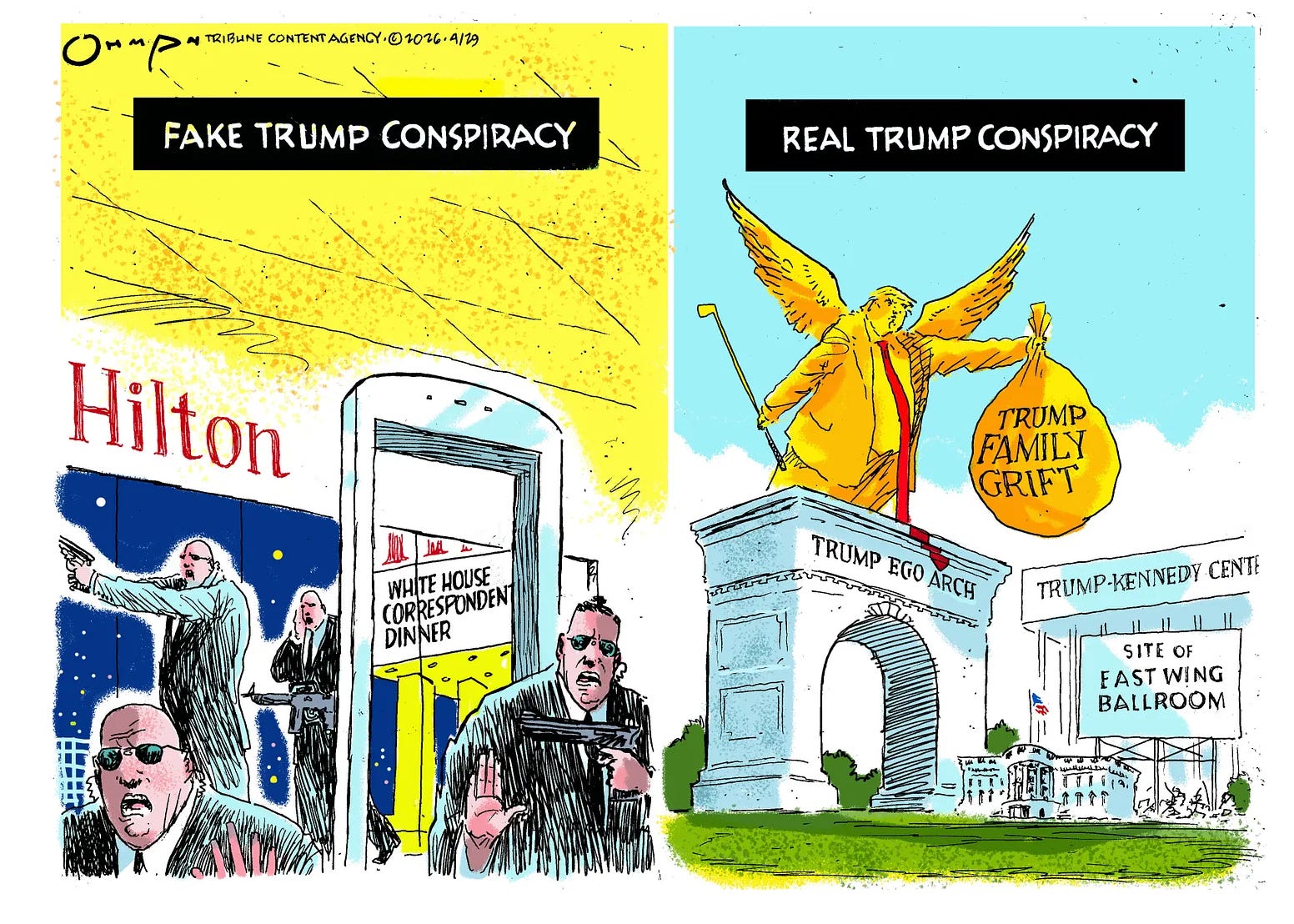
Fresh from the president using the incident at the White House Correspondents Dinner to sell the “urgency” of constructing his ballroom, the cost of the project has now apparently soared, with taxpayers set to be on the hook for a billion dollars in “security adjustments and upgrades” – despite the president’s repeated assurances that the work would be paid for by donations.
NPR reported:
“After last week’s bipartisan vote in Congress to end the longest shutdown in U.S. history and fund the Department of Homeland Security, Republicans are moving ahead with an approximately $70 billion, party-line plan to fund Immigrations and Customs Enforcement (ICE) and Customs and Border Protection (CBP) for the rest of President Trump’s time in the White House.”
There are, however, fears among some Republicans that Trump’s pre-occupation with the ballroom, along with the potential costs, could be just one more thing that exacerbates popular frustration with the GOP among voters who are already experiencing economic hardship. Greg Sargent’s podcast at The New Republic spells it out:
“A key reason: Trump’s obsession with his ballroom and other pet projects is muddying the GOP economic message. That’s bad enough. Worse, Republicans just agreed to seek $1 billion in taxpayer money for the ballroom. Though this is allegedly for security, vulnerable Republicans will hate having to defend this. It’s not just that they themselves are lamenting that the project is distracting from their economic message. It’s also that the ballroom is already deeply unpopular and they’re now tied more tightly to it.”
Yet, despite any “misgivings” or handing the Dems an obvious campaign gift, Republican politicians still seem to go out of their way to talk about what – they surely know – would be deeply unpopular policies.
Meanwhile, with absolutely delicious timing The Atlantic’s Sarah Fitzpatrick responded to the FBI’s apparent “investigation” into her, as well as Director Kash Patel’s defamation lawsuit over her article alleging excessive drinking…
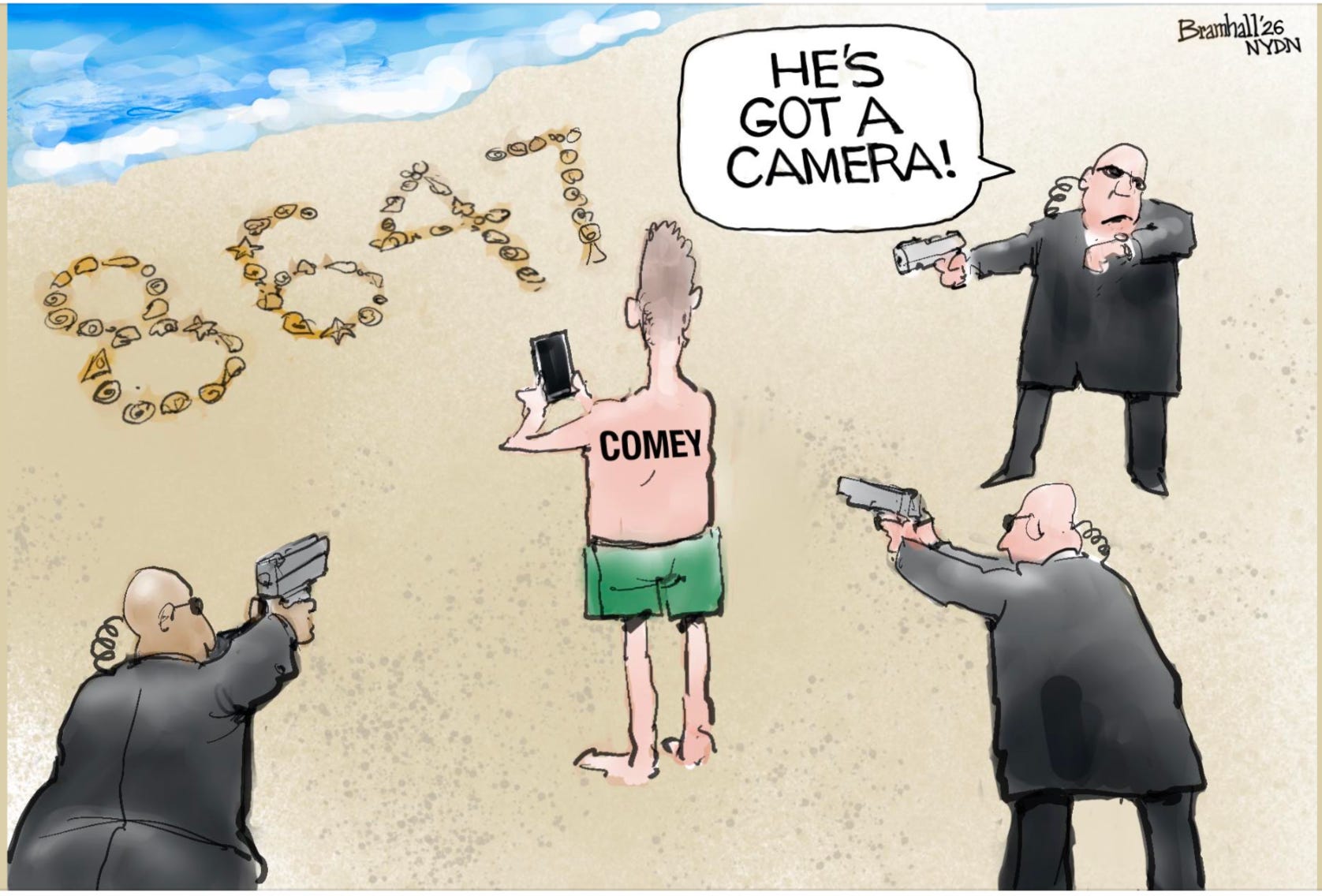
Regular as clockwork, the DOJ again went after former FBI Director James Comey and late-night comic Jimmy Kimmel.
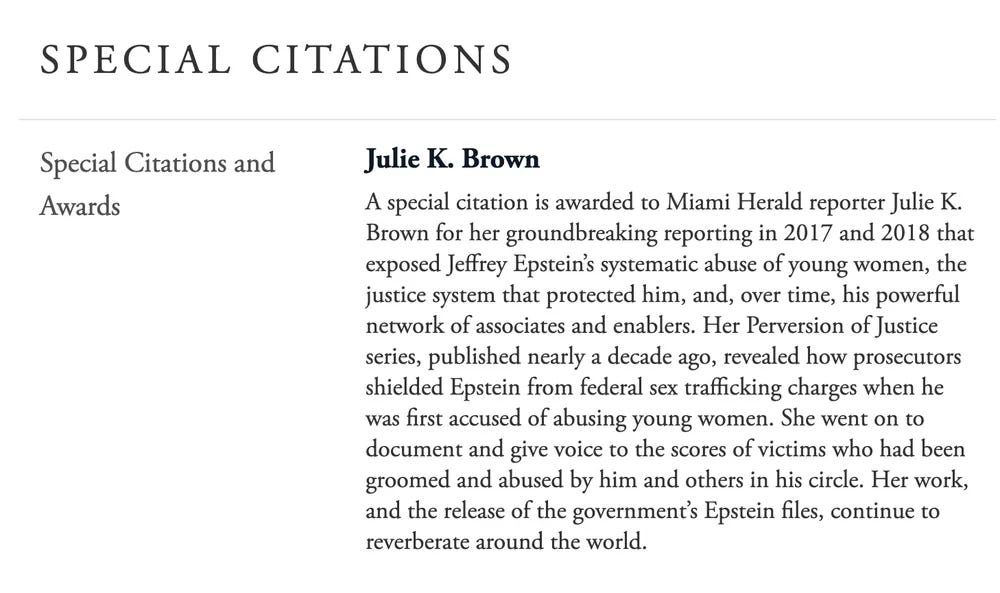
As Trump’s Commerce Secretary Howard Lutnick gave evidence to congress about his ties to Jeffrey Epstein, the Pulitzer Prize committee this week awarded a special citation to Julie K Brown, the Miami Herald reporter whose “groundbreaking reporting” had exposed Epstein’s abuse a decade ago.
See Also:
Amazing Grace (From July 2025)
There Will Be Others (From September 2025)
‘The Easy Way Or The Hard Way?’ (From September 2025)
Happy Birthday To Me (From February)
***
As always, thanks for reading. When I started this project in 2022, I simply did not expect how wildly out of whack things in the political world were about to become; all while sports continue to show the face of a society functioning with what passes for ‘normality’.
As for how all of this ends – and what might come after – I have no idea. And if anyone tells you they do, they’re just plain wrong. Unpredictability at home and abroad has become the touchstone of how we have decided to govern ourselves and there will be plenty of collateral damage before the dust clears.
The two links in the above paragraphs change with each weekly column – the pieces are definitely worth reading. They’re all linked here:
*
During the regular season I aim to write a baseball-related post midweek and a politics wrap at weekends. As you might expect, one has been relatively more sane than the other.
I’ll also be sending out some invites for more Q&A write-ups and will aim to produce some new content for the site.
Let me know what you’ve enjoyed or what you haven’t? And if you think you might like to take part and talk about your memories of baseball and politics, drop me a line? Here’s how it works.
You can, of course, find a full States of Play substack archive here, and the original site here.
*